
Quick Answer
Yes, all rice contains some arsenic, including organic rice, because rice plants absorb it from soil and water more readily than most crops. The type that matters for health is inorganic arsenic. For most adults, eating rice in moderation as part of a varied diet is fine, but the amount of rice you eat and the type you pick both matter, especially for babies and young children. White basmati and sushi rice tested lowest in Consumer Reports' 2026 analysis, brown rice tested higher, and cooking rice in a large amount of water and draining it can cut inorganic arsenic by roughly 30% to 60% depending on the method. Rinsing alone does very little.
You've probably seen the headlines. In July 2026, Consumer Reports published a new analysis of rice products and called on regulators to set limits for more of them. If you cook rice several times a week, or feed it to a baby, it's reasonable to want a clear answer. This guide covers what arsenic in rice actually is, how worried you should be, which rice is lowest, whether organic helps, and what to do in your own kitchen. At SFMart, you can explore a range of staples including organic rice, grains, flours and much more to help you with your kitchen errands everyday.
Why Does Rice Contain Arsenic?
Arsenic occurs naturally in soil and groundwater, and past use of arsenic-containing pesticides has added to it in some regions. Rice is unusual because it's grown in flooded paddies. Those conditions make arsenic in the soil more available to the plant, and rice takes it up more efficiently than most other grains. It then collects in the grain.
There are two broad forms. Organic arsenic (a chemistry term, unrelated to organic farming) is generally considered less harmful. Inorganic arsenic is the form linked to long-term health risks, and it's the one that regulators and testers focus on. When you see figures in parts per billion (ppb) for rice, they usually refer to inorganic arsenic.
Is Arsenic in Rice Actually Dangerous?
It depends on how much you eat, how often, and who is eating it. Arsenic is a known carcinogen, and long-term exposure at higher levels is linked to cancers, heart disease and type 2 diabetes. But a single bowl of rice isn't a poisoning risk. The concern is the cumulative effect of eating rice often over years.
Consumer Reports tested 52 rice products and reported that in 42% of them, the average inorganic arsenic level was high enough that an adult eating one serving a day over time would face a significantly increased risk of skin cancer, bladder cancer and type 2 diabetes. That's Consumer Reports' own risk assessment, and not a legal limit. There is no federal limit for inorganic arsenic in rice as a whole. The FDA has set one for infant rice cereal, with an action level of 100 ppb, and Consumer Reports has asked regulators to extend limits to more rice products.
So the honest answer is that it's a real but manageable risk, and one that shifts depending on your habits. Risk is highest for people who eat a lot of rice, and for infants and young children, since they eat more food relative to their body weight. Consumer Reports notes that exposures during pregnancy, infancy and early childhood carry the most serious risks.
Which Rice Has the Least Arsenic?
Consumer Reports' averages for inorganic arsenic by rice type were:
|
Rice type |
Average inorganic arsenic |
|
White basmati |
55 ppb |
|
Sushi rice |
57 ppb |
|
Arborio |
64 ppb |
|
White rice overall |
72 ppb |
|
Long-grain and short-grain white, and parboiled |
101 ppb |
|
Brown rice |
113 ppb |
Source: Consumer Reports, 2026. Averages vary by brand and region.
A few points are worth noting. Basmati and sushi rice came out lowest. Consumer Reports' advice singles out white basmati from California, India or Pakistan, as well as sushi rice, as the better choices, and for those it suggests up to 5 servings a week for adults and about 2¾ for children. For most other rice, its limits are about 2¾ servings a week for adults and 1¼ for children, where a serving is ¼ cup of dry rice.
On jasmine, the picture isn't as simple as some articles suggest. Consumer Reports did not single out white jasmine as a low-arsenic rice, and the highest single result it reported for a product, a brown jasmine rice, was 155 ppb. So don't assume that all aromatic rice is low. On sweet or glutinous rice, we couldn't find comparable published testing, so we can't say how it compares. If you're curious about the grain itself, our guide to what glutinous rice is explains how it differs from regular rice.
Is White Rice Safer Than Brown Rice?
On arsenic alone, yes. Arsenic concentrates in the outer bran layer of the grain, which brown rice keeps and white rice has milled away. Consumer Reports found brown rice averaged 113 ppb against 72 ppb for white.
But arsenic isn't the whole story. Brown rice has more fiber, magnesium and other nutrients because of that bran, and white rice usually has less. For most adults, that means the choice is a balance: eat both, vary your grains, and don't rely on any single type every day. Our guide on which rice is best for consumption compares white, brown, black and mixed rice on nutrition, and if you prefer whole-grain rice, SFMart's organic brown rice and organic white rice collections cover both. Whole-grain rice also has a shorter shelf life because of its natural oils, which is covered in can rice go bad or expire.
Does Organic Rice Have Less Arsenic?
Generally, no. Organic farming rules limit synthetic pesticides and fertilizers, but they don't change how rice plants absorb arsenic that's already in the soil and water. Where the rice was grown tends to matter more than whether it's organic. Even The Organic Center, an organization that promotes organic agriculture, states that there is no difference in the amount of arsenic taken up by organic versus conventional rice.
That doesn't make organic rice a bad choice. People choose it for other reasons, such as avoiding synthetic pesticide residues. It just means you shouldn't buy organic rice expecting it to be arsenic-free, and it's worth treating all rice the same way when it comes to portion sizes and cooking. We cover this in more depth in does organic rice have arsenic.
How Do You Cook Rice to Remove Arsenic?
Arsenic dissolves into cooking water, so how you cook matters. Researchers have tested several methods, and the figures vary, so here is what the main sources say:
- Parboil and absorb (Consumer Reports). Boil the rice in plenty of water for about 5 minutes, drain it, then add fresh water and finish cooking. Consumer Reports found this reduced inorganic arsenic by 50% to 58%.
- Cook like pasta (FDA). The FDA says using 6 to 10 parts water to 1 part rice and then draining the excess can reduce inorganic arsenic by 40% to 60%.
- A peer-reviewed lab study. A study in PLOS ONE found that cooking in a 12:1 water-to-rice ratio removed about 57% of inorganic arsenic on average, but at 6:1 and 3:1 ratios, only about 29%. It also tested percolating methods, which removed more but are less practical at home.
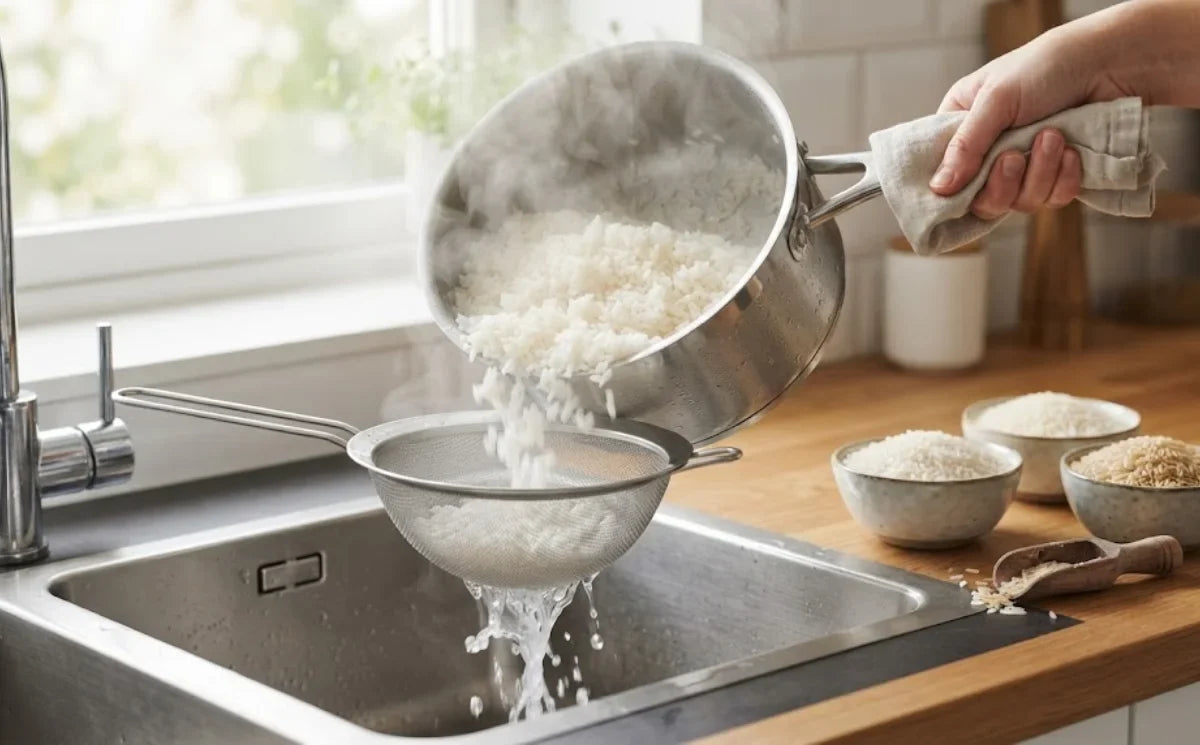
The sources don't agree exactly, which is why you see a range rather than one number. The takeaway is consistent: more water and draining beats the usual absorb-all-the-water method, and the more water you use, the more arsenic goes down the drain. If you want a simple routine, cook rice in a large pot of water, like pasta, and drain it, or use the parboil-and-absorb method.
There is a trade-off. The FDA notes that cooking with excess water and draining can reduce the folate, iron, niacin and thiamine in enriched rice by 50% to 70%, and the PLOS ONE study found a large loss of potassium with one method. For most people eating a varied diet that's an acceptable cost, but it is a cost.
Does Rinsing Rice Help?
Barely. The FDA says rinsing rice before cooking has a minimal effect on the arsenic content, and Consumer Reports found that rinsing or soaking removed less than 8%. Rinsing is still useful for texture, since it removes surface starch, and for removing dust, but don't rely on it for arsenic.
Is Rice Safe for Babies and Toddlers?
Rice isn't off the menu, but variety matters. The FDA recommends feeding infants a variety of grains and notes that oat, barley and multigrain cereals are alternatives to rice cereal, in line with American Academy of Pediatrics advice. Consumer Reports suggests white basmati from California, India or Pakistan, or sushi rice, as better options for young children, and keeps its limit for children lower than for adults.
A few practical points for families:
- Offer a range of grains such as oats, barley, quinoa and wheat alongside rice. Consumer Reports found that oats, quinoa, farro and sorghum contained significantly less arsenic than all the rice varieties it tested.
- Use the more-water cooking method for rice you serve to children.
- Be careful with rice-based snacks, rice drinks and rice cereal, which can add up quickly. If you're unsure what is right for your child, ask your pediatrician.
Should You Stop Eating Rice Because of Arsenic?
For most people, no. Rice is a staple for billions of people, and the risk comes from frequent, heavy consumption rather than occasional servings. A sensible approach would be:
- Vary your grains: Rotate rice with quinoa, oats, barley, millet and other whole grains. Our guide to organic rice for weight management is one starting point for balanced meals.
- Choose lower-arsenic rice more often: White basmati and sushi rice came out best in testing. SFMart's organic white rice collection includes organic sushi rice, though we can't claim that any specific product tests lower in arsenic without independent testing.
- Cook with plenty of water and drain: This is the most effective step you can control at home.
- Watch portions, especially for children: Use Consumer Reports' serving guidance as a reference.
- Don't rely on a single type: If you enjoy whole-grain varieties such as organic black rice, enjoy them as part of a mix.
When rice is stored well it also lasts longer, so you can buy in bulk and rotate stock. Our guide on how to store rice long term covers how, and the guide to buying bulk organic rice is useful if you're stocking up.
Final Thoughts
Arsenic in rice is a real issue, but it's one you can manage without giving up a food you enjoy. Mix up your grains, pick lower-arsenic types when you can, cook rice in plenty of water and drain it, and be particularly careful with babies and toddlers. No type of rice is arsenic-free, so a balanced approach is more reliable than looking for a perfect product.
Stocking your pantry? Browse SFMart's organic white rice, organic brown rice and organic black rice collections, or explore the full organic rice range.


