
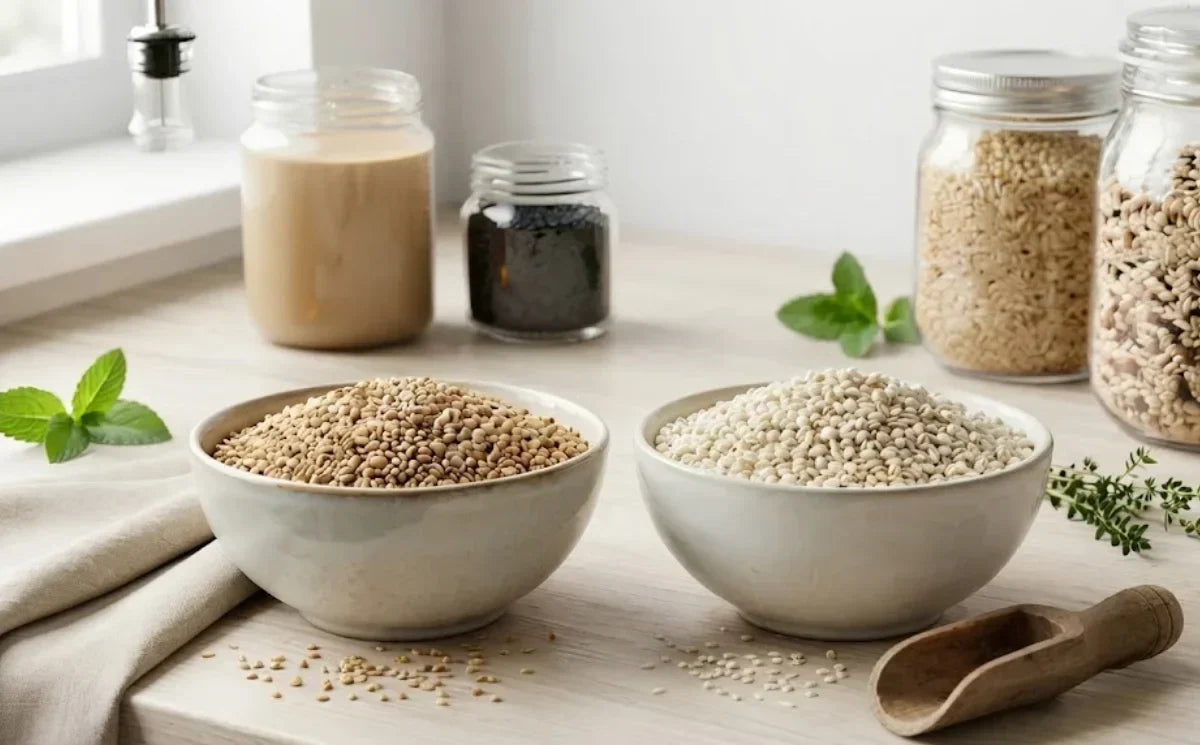
If you have ever seen a bag labeled "Chinese pearl barley," "coix seed," "Job's tears," or "yi yi ren" and wondered whether you were looking at barley, you are not alone.
Job's tears is one of those grains with an unusually confusing name. It looks somewhat like barley, is sometimes sold as Chinese pearl barley, and is used in soups, teas, porridges, grain bowls, and desserts. But botanically, 'Job's tears' is not barley at all.
'Job's tears' comes from Coix lacryma-jobi, a grass native to tropical Asia. Barley comes from Hordeum vulgare. Both belong to the grass family, Poaceae, but they are different plants.
That distinction matters, especially if you are looking for a gluten-free grain or simply want to understand what you are actually buying.
This guide explains what Job's tears is, why it gets mislabeled as barley, Job's tears benefits, how it compares with pearl barley, how long to soak Coix seed, how to cook it, and how to make Korean yulmu cha at home.
What Is 'Job's Tears'?
Job's tears is the edible seed of Coix lacryma-jobi, a tall grass related more closely to corn than to barley. It is also known as:
- Coix seed
- Coix
- Adlay or adlay millet
- Hato mugi or hatomugi
- Yi yi ren
- Chinese pearl barley
- Pearl barley in some Asian markets
The cultivated food variety is commonly associated with Coix lacryma-jobi var. ma-yuen. In Chinese food and traditional medicine, it is known as yi yi ren (薏苡仁). In Japan, you may see hato mugi, while in Korea it is commonly associated with yulmu.
The name "Job's tears" comes from the seed's distinctive tear-like appearance. Some varieties have hard, bead-like shells and have historically been used for decorative beads, while cultivated food varieties have softer coverings and are grown as a cereal crop.
Once processed for food, the grain is usually pale, rounded or oval, and somewhat pearl-like.
What does Job's tears taste like?
If you are trying it for the first time, expect something between a grain and a chewy seed.
Cooked Job's tears have a:
- Mildly nutty flavor
- Slight natural sweetness
- Firm, chewy texture
- Pleasantly substantial bite
Unlike rice, it does not become fluffy and soft. Unlike pearl barley, it tends to hold its shape particularly well when cooked.
That texture makes it useful in everything from soups and salads to grain bowls and breakfast porridges.
Is Job's Tears the Same as Barley?
No. Job's tears and barley are not the same grain.
This is the single most important thing to know.
Job's tears comes from the Coix genus, while barley comes from the Hordeum genus. They are both grasses, but they are botanically distinct.
The confusion largely comes from the name "Chinese pearl barley." In Asian markets, Job's tears has historically been sold under barley-related names because of its appearance and culinary uses. Some sources also note that shipments of shelled Coix were historically declared as pearl barley, helping the misleading name stick. (For a deeper look at barley terminology itself, see SFMart's Hulled vs. Pearl Barley comparison.)
So if a package says "Chinese pearl barley," do not automatically assume it contains barley.
Look for terms such as Coix seed, Job's tears, adlay, hato mugi, yi yi ren, or Coix lacryma-jobi.
Job's Tears vs. Pearl Barley: What's the Difference?
Job's tears and pearl barley can sometimes be substituted for each other in recipes, but they are not interchangeable in every situation.
| Feature | Job's Tears / Coix Seed | Pearl Barley |
|---|---|---|
| Botanical name | Coix lacryma-jobi | Hordeum vulgare |
| Plant family | Poaceae | Poaceae |
| Same grain? | No | No |
| Gluten | Naturally gluten-free | Contains gluten |
| Texture | Firm, chewy and substantial | Softer and more tender |
| Flavor | Mild, nutty and slightly sweet | Mild, earthy and malty |
| Common uses | Soups, teas, porridges, salads, grain bowls | Soups, stews, salads, grain dishes |
| Asian names | Coix, yi yi ren, hato mugi, yulmu | Barley varieties have their own names |
| Common confusing name | Chinese pearl barley | Pearl barley |
The gluten distinction is particularly important.
Plain Job's tears is naturally gluten-free, whereas barley contains gluten. However, if you have celiac disease or need to avoid gluten strictly, check the package for appropriate gluten-free labeling and cross-contact information rather than relying only on the ingredient name. (SFMart's guide on which ancient grains are actually gluten-free covers this in more detail.)
For example, SFMart's McCabe Organic Coix Seed is processed in a facility that also handles wheat, peanuts, soy, sesame and perilla seeds, so shoppers with severe allergies or celiac disease should take the product's facility information into account.
Why Is Job's Tears Called Chinese Pearl Barley?
The answer is mostly appearance and culinary tradition.
Processed Job's tears can look remarkably similar to pearled barley. Both are pale, rounded grains that become pleasantly chewy after cooking. Both can be simmered in soups, added to grain dishes, or cooked into porridges.
But the similarity ends there botanically.
The term "Chinese pearl barley" is essentially a common market name, not proof that the grain is barley.
This is why shopping by the scientific or traditional name can be helpful. If you specifically want Coix, look for:
- Coix seed
- Job's tears
- Adlay
- Hato mugi
- Yi yi ren
- Coix lacryma-jobi
And if you specifically want actual barley, look for Hordeum vulgare or a barley variety such as pearled barley.
Job's Tears Benefits: What Does the Research Actually Say?
Job's tears has a long history as both food and traditional medicine in East Asia. Modern research has also investigated its nutritional composition and various bioactive compounds.
But there is an important distinction between traditional uses, nutritional benefits, and clinically proven health effects.
It is reasonable to include Job's tears as a nutritious whole-grain-style food. It is not reasonable to treat it as a cure for a medical condition.
1. It provides dietary fiber
Coix seeds contain dietary fiber along with starch and other carbohydrate components. Fiber is important for normal digestion and can contribute to satiety as part of an overall balanced diet.
That makes cooked Job's tears an interesting alternative when you want to move beyond the usual rice, oats, or wheat-based grains.
2. It provides plant protein
Research on Coix seed has found meaningful protein content, with studies reporting variation depending on the variety and sample.
It should not be thought of as a high-protein food in the same category as beans or lentils, but it can contribute some plant protein to a meal.
If you are building a grain bowl, for example, combining Coix with beans, lentils, vegetables and a protein source creates a much more complete meal than eating the grain alone.
SFMart also carries a range of organic beans and lentils, making it easy to pair different plant foods rather than relying on a single grain for nutrition.
3. It contains naturally occurring plant compounds
Coix seed contains various bioactive compounds, including polyphenols and other plant constituents that have been investigated in laboratory and preclinical research.
Research has explored antioxidant, anti-inflammatory and other biological activities associated with Coix compounds. However, much of this evidence is from laboratory, animal or preliminary research.
In other words, Job's tears is an interesting nutritious food, but research on its potential therapeutic effects should not be confused with proof that eating the grain treats or prevents disease. (For a closer look specifically at Coix and immunity, see SFMart's A Natural Boost: How Coix Seed Supports Your Immune System.)
4. It can add variety to a whole-grain-focused diet
One of the simplest benefits of Job's tears may be its versatility.
You can use it in:
- Grain bowls
- Soups
- Stews
- Salads
- Breakfast porridge
- Congee-style dishes
- Grain teas
- Korean yulmu cha
- Desserts
- Mixed-grain dishes
For people who eat rice frequently, adding a different grain can make everyday meals more interesting without requiring an entirely new cooking style.
SFMart's organic grains collection includes Coix alongside options such as quinoa, Kamut, rye berries, oats, millet and several barley varieties.
Job's Tears Benefits for Skin: Is It Really Good for Your Skin?
This is one of the most searched questions about Coix seed, largely because Job's tears has a long history in traditional Asian wellness practices.
Traditional Chinese medicine has used adlay/Coix seed in preparations associated with various skin and inflammatory concerns. Modern research has also investigated Coix-derived compounds and their biological activity.
But the evidence needs some context.
Eating Job's tears does not have a proven "skin-clearing" or anti-aging effect in humans simply because the grain contains antioxidants or has traditional skin-related uses.
What we can say is that it provides fiber, nutrients and naturally occurring plant compounds as part of a balanced diet. Those qualities make it a nutritious food, but they should not be marketed as a guaranteed treatment for acne, pigmentation, eczema, wrinkles or other skin conditions.
If you see claims online that Coix seed "detoxes the skin," "cures acne," or dramatically changes complexion, treat those claims cautiously.
The traditional reputation is interesting. The clinical evidence is a separate question.
How Long to Soak Coix Seed?
Soaking makes Job's tears easier and faster to cook.
Recommended soaking time
For most home cooks, 1–2 hours is a practical minimum, while an overnight soak can make the grain even easier to cook.
SFMart's own cooking instructions for its McCabe Organic Coix Seed recommend rinsing and soaking for 1–2 hours, followed by boiling for approximately 45 minutes or until tender.
Other cooking methods recommend longer soaking times, particularly for harder or less processed Coix seeds.
So there isn't one magic soaking time.
A good rule is:
- 1–2 hours: convenient and usually sufficient
- 4 hours: useful if you want to shorten cooking time further
- Overnight: convenient for meal prep and typically produces a more tender result
If your package provides specific instructions, follow those first because processing can vary between products.
How to Cook Job's Tears
Cooking Job's tears is not difficult. The biggest mistake is treating it like white rice.
It needs more time and water.
Basic stovetop method
Ingredients
- 1 cup dry Job's tears
- 3–4 cups water
- Pinch of salt, optional
Step 1: Rinse
Place the Coix seeds in a fine-mesh strainer and rinse thoroughly under cool running water.
This removes surface dust and any loose particles.
Step 2: Soak
Transfer the rinsed seeds to a bowl and cover generously with water.
Soak for 1–2 hours, or overnight if convenient.
Step 3: Drain
Drain the soaking water and rinse the seeds again.
Step 4: Simmer
Add the soaked Job's tears to a pot with fresh water.
Bring it to a boil, then reduce the heat and simmer gently.
For soaked Coix, start checking for doneness around 40–45 minutes. Depending on the grain and how soft you want it, it may take longer.
SFMart's product instructions similarly recommend soaking for 1–2 hours and boiling for about 45 minutes until soft.
Step 5: Check the texture
Perfectly cooked Job's tears should be tender enough to bite through but still pleasantly chewy.
If the center is hard, continue simmering and add a little more water if necessary.
Step 6: Drain
Once tender, drain any remaining water.
You can now use the cooked Coix immediately or refrigerate it for later meals.
Can You Cook Job's Tears Without Soaking?
Yes.
But soaking is usually the easier approach.
Unsoaked Coix seeds can take longer to become tender, and the cooking time can vary considerably depending on the grain's processing and age.
If you forgot to soak it, simply rinse it well, use plenty of water, and simmer until tender. You may need to add additional hot water during cooking.
For regular meal preparation, soaking is worth the small amount of planning.
How to Use Cooked Job's Tears
Once cooked, think of Job's tears as a versatile grain rather than a specialty ingredient that can only be used in Asian recipes.
Add it to soups
Its firm texture makes it excellent in vegetable, chicken and mushroom soups.
Unlike softer grains, it can retain some bite even after simmering.
Make a grain bowl
Combine cooked Coix with:
- Roasted vegetables
- Leafy greens
- Tofu or chicken
- Beans
- Sesame seeds
- A soy-ginger dressing
The chewy grain works particularly well with crunchy vegetables and creamy sauces.
Add it to salads
Cool cooked Job's tears and mix it with cucumber, carrots, herbs, greens and a simple vinaigrette.
It makes a more substantial salad without relying on pasta.
Use it as a rice alternative
You can serve cooked Coix alongside curries, stir-fries and vegetable dishes.
If you already enjoy experimenting with different rice varieties, SFMart's organic rice collection includes organic white, brown, sweet, brown sweet, sushi and Haiga Mai rice, giving you plenty of options for building a varied grain-based pantry.
Mix it with other grains
Try combining a small amount of cooked Job's tears with brown rice, millet, quinoa or other grains.
SFMart's organic mixed grain selection is another useful reference if you enjoy the texture and variety that comes from combining grains.
How to Make Yulmu Cha at Home
If you have never tried yulmu cha, this is one of the most interesting ways to experience Job's tears.
Yulmu cha is a Korean grain drink traditionally made with powdered roasted Job's tears. It is thicker and more substantial than a typical herbal tea, with a toasted, nutty flavor.
Commercial versions may contain additional grains, nuts, sweeteners or milk powders, but you can make a simple version at home.
Easy homemade yulmu cha
Ingredients
- 2–3 tablespoons roasted Job's tears powder
- 1 cup hot water
- Milk or plant milk, optional
- Honey, maple syrup or sugar, optional
- Small pinch of salt, optional
Method
- Add the Job's tears powder to a cup or small saucepan.
- Add a small amount of cool or warm water first and stir into a smooth paste. This helps prevent lumps.
- Gradually add the remaining hot water while stirring.
- Heat gently if you want a thicker drink.
- Add milk or plant milk if desired.
- Sweeten to taste.
Traditional-style preparations can also combine Job's tears powder with glutinous rice powder, milk and honey for a creamier drink.
For a pantry-friendly version, start with roasted Coix powder and adjust the amount according to how thick you like your drink.
What Is Hato Mugi?
Hato mugi is the Japanese name commonly associated with Job's tears.
You may encounter it in Japanese teas, grain blends and health-food products.
The word can appear on packaging instead of "Job's tears," which is why knowing the alternative names is useful when shopping online or in Asian grocery stores.
If you are searching for it in the United States, try:
- Job's tears
- Coix seed
- Hato mugi
- Adlay
- Yi yi ren
- Yulmu
- Chinese pearl barley
This can dramatically expand your search results.
Where to Buy Organic Job's Tears
Job's tears is still less common in mainstream American grocery stores than rice, oats or barley, so Asian supermarkets, specialty food stores and online organic grocery retailers can be easier places to find it.
When buying, check the label carefully.
What should you look for?
Look for:
- Coix seed or Job's tears as the product name
- Coix lacryma-jobi where available
- Organic certification if that matters to you
- Country of origin
- Packaging and storage information
- Allergen/cross-contact statements
- Whole, clean-looking grains without excessive broken pieces or debris
For shoppers looking specifically for an organic option in the U.S., SFMart's McCabe Organic Coix Seed (Job's Tear) is a particularly direct match. It is a 2-pound product described by SFMart as USDA and CCOF organic certified, and the product page includes its soaking and cooking instructions.
SFMart places Coix in its organic small grains collection alongside products such as organic millet, quinoa, Kamut and rye berries.
That makes sense for shoppers who are building a pantry around less-common whole grains rather than buying a single specialty ingredient.
How Should You Store Job's Tears?
Like other dry grains, uncooked Coix seed should be protected from moisture, heat and sunlight.
Keep it:
- In an airtight container
- In a cool, dry pantry
- Away from direct sunlight
- Away from moisture and humidity
For longer storage, refrigeration can be useful, particularly after opening. SFMart specifically recommends refrigerating its Coix seed after opening to help maintain freshness.
If you cook a large batch, let it cool before transferring it to an airtight container and refrigerating it.
For additional pantry-storage reading, SFMart's guide Can Rice Go Bad or Expire? offers useful general guidance on keeping dry grains fresh.
Job's Tears vs. Other Popular Grains
Job's tears is particularly interesting because it sits somewhere between familiar pantry staples and specialty grains.
Job's Tears vs. Rice
Rice tends to cook faster and has a softer texture, especially white rice.
Job's tears is chewier, more substantial and usually requires soaking and a longer simmer.
Job's Tears vs. Barley
This is the most important comparison.
Barley and Coix are different plants. Pearl barley contains gluten; plain Coix seed is naturally gluten-free. (See SFMart's guide on regular pearled barley for more on barley itself.)
Job's Tears vs. Millet
Both may be described as ancient or alternative grains, but they have different textures.
Millet tends to become soft and fluffy or creamy depending on how it is cooked, while Job's tears generally stays chewy.
Job's Tears vs. Quinoa
Quinoa is much smaller and cooks relatively quickly. Job's tears takes longer but offers a more substantial, almost pearl-like chew. (SFMart's Quinoa vs Rice guide is a useful related comparison if you're deciding between grains.)
The best choice depends less on which grain is "healthiest" and more on what you want to cook.
Is Job's Tears a Millet?
You may see Job's tears called adlay millet or Coix millet.
That does not mean it is the same thing as the millet commonly sold in U.S. grocery stores.
Job's tears belongs to the genus Coix, whereas common millet is generally associated with other genera, including Panicum and Setaria, depending on the species.
So "adlay millet" is a common name rather than a reason to assume it is identical to conventional millet.
Is Job's Tears Gluten-Free?
Pure Job's tears is naturally gluten-free.
That makes it an interesting alternative to wheat, barley and rye for people following gluten-free diets.
However, the product itself and its processing environment matter.
If you have celiac disease or a medically necessary gluten-free diet, do not rely solely on the botanical identity of the grain. Check the product label for gluten-free certification and allergen/cross-contact information.
This distinction is especially important with specialty grains because a naturally gluten-free ingredient can still be exposed to gluten during processing or packaging. (For a full breakdown by grain, see which ancient grains are actually gluten-free.)
Does Job's Tears Have Caffeine?
No. Plain Job's tears is naturally caffeine-free.
Yulmu cha made from roasted Job's tears is therefore a grain-based beverage rather than a caffeinated tea in the traditional sense.
However, always check commercial yulmu cha mixes because some products may contain other ingredients.
Can You Eat Job's Tears Every Day?
For most people, Job's tears can simply be treated as a food grain and incorporated into a varied diet.
There is no need to consume large quantities to obtain its nutritional benefits. A practical approach is to rotate it with other grains such as rice, oats, quinoa, millet and barley.
As with any food, individual tolerance matters.
And if you are pregnant, have a medical condition, take medications, or are considering concentrated Coix supplements rather than ordinary food portions, discuss that use with a qualified healthcare professional. Traditional medicinal claims about Coix should not be treated as established medical advice.
The Bottom Line
Job's tears is a fascinating grain largely hidden behind a misleading name.
It is Coix seed, not barley. It may be called Chinese pearl barley, adlay, hato mugi or yi yi ren, depending on where you shop. Its firm, chewy texture makes it useful in soups, salads, porridges and grain bowls, while roasted Coix can be used to make yulmu cha.
Nutritionally, Job's tears provides carbohydrates, fiber, plant protein and naturally occurring plant compounds. Research into its potential health effects is promising in some areas, but many therapeutic claims remain preliminary and should not replace evidence-based medical care.
For American shoppers, the easiest way to avoid the barley confusion is simple: check the botanical identity and look for "Coix seed" or "Job's tears" on the package.
And if you want to experiment with it at home, start with a small batch: rinse it, soak it for 1–2 hours, simmer until tender, and use it wherever you would normally reach for a chewy grain.
For those building a more varied organic pantry, SFMart's organic grains collection is a natural place to explore beyond Coix, with organic rice, oats, quinoa, millet, barley and other grains available alongside it.
You can also explore SFMart's related guides, including A Natural Boost: How Coix Seed Supports Your Immune System for a deeper look at Coix seed, Organic Oats vs. Regular Oats when comparing everyday grains, and its guide to buying good-quality organic rice online in the USA if you are expanding your pantry beyond conventional staples.


