
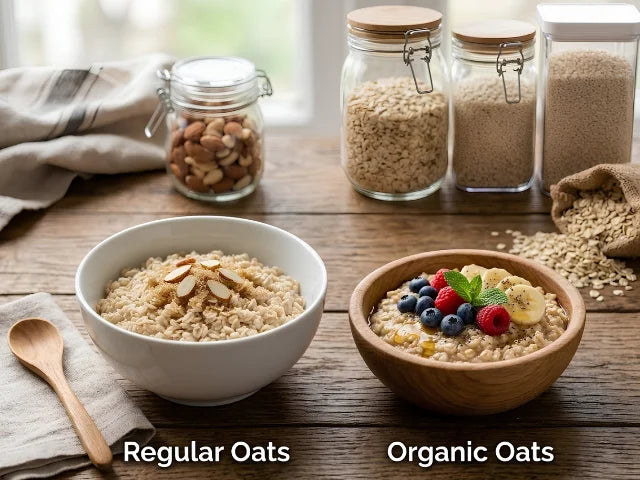
Walk down any cereal aisle and you'll notice the same oats sitting in two different bags: one labeled "organic," priced a dollar or two higher, and one plain, conventional canister sitting right next to it. The nutrition facts panels look almost identical. So why does one cost more, and is it actually doing anything for your health?
This comes up constantly, especially since a string of headlines in recent years about glyphosate (the active ingredient in Roundup) turning up in oat-based products. Below, we'll go through what "organic" actually means for oats, what the pesticide testing has shown, whether it changes the nutrition or taste, and how to decide if it's worth it for your household; kids included. You can also explore SFMart’s diverse collection of oats, grains, rice and much more because we offer premium quality that surely does not hurt your packet one bit!
What Does "Organic" Actually Mean for Oats?
In the US, oats labeled "USDA Organic" have to meet standards set by the USDA's national organic program. That means the oats were grown:
- Without synthetic pesticides or herbicides
- Without synthetic fertilizers
- Without genetically modified seed (GMO)
- On land that's been free of prohibited substances for at least three years before harvest
Regular (conventional) oats have no such restrictions. Farmers growing conventional oats can use synthetic herbicides and pesticides as part of standard crop management, including, in some cases, glyphosate as a pre-harvest desiccant; a practice that's become one of the biggest points of concern for consumers.
It's worth noting: "organic" is a farming and processing standard, not a nutrition claim. The USDA organic seal tells you how the oats were grown, not that they contain more fiber or protein. That distinction matters for understanding the rest of this comparison.
Organic Oats vs Regular Oats: Nutrition Facts Comparison
| Nutrient (per 1/2 cup dry, ~40g) | Organic Oats | Regular Oats |
|---|---|---|
| Calories | ~150 | ~150 |
| Protein | ~5g | ~5g |
| Fiber | ~4g | ~4g |
| Fat | ~3g | ~3g |
| Carbohydrates | ~27g | ~27g |
| Iron, Magnesium, B vitamins | Comparable | Comparable |
Nutritionally, organic and conventional oats are essentially the same. The oat groat itself ; whether steel cut, rolled, or instant ; doesn't change its fiber or protein content based on farming method. Any brand-to-brand nutrition differences you see are almost always due to oat type or processing (steel cut vs. rolled vs. instant), not organic vs. conventional status.
So if nutrition on the label is identical, what's actually different? It comes down to what's not listed on the nutrition panel: pesticide and herbicide residue.
Glyphosate in Oats: What the Testing Actually Found
This is the single biggest reason "organic oats vs regular oats" is such a heavily searched topic, so it deserves a real answer rather than a vague one.
Glyphosate is a widely used herbicide. In conventional oat farming, it's sometimes sprayed shortly before harvest as a desiccant, meaning it dries down the crop to make it ready for harvest faster and more uniformly. This pre-harvest application is different from using it earlier in the growing season to control weeds, and it's the practice most linked to residue actually ending up in the final oat product, since there's less time for the chemical to break down before the grain is processed.
Independent testing ; including reports from environmental and consumer advocacy groups over the past several years ; has found measurable glyphosate residue in a number of popular conventional oat-based cereals, granolas, and oatmeal products sold in the US. Some of these tests found residue levels below EPA safety thresholds, while others flagged levels of concern, particularly in products marketed toward children. Certified organic oat products, by contrast, have consistently tested at little to no detectable glyphosate, since the practice of using it as a pre-harvest desiccant isn't permitted under organic certification.
A few important caveats worth understanding:
- The EPA sets a legal limit for glyphosate residue in food, and most tested conventional oat products fall under that limit.
- "Detectable" doesn't automatically mean "dangerous" ; trace residue and a harmful dose are two different things, and the two shouldn't be conflated.
- Long-term research on low-dose glyphosate exposure from food is still evolving, and health agencies internationally don't fully agree on what an acceptable exposure level looks like, which is part of why this remains a genuinely debated topic rather than a settled one.
If glyphosate exposure specifically is your main concern, organic oats are the more consistent way to reduce it, based on available testing data ; but it's fair to acknowledge the science on low-level exposure is still developing.
Which Oat Brands Test Positive for Glyphosate?
This is one of the most frequently searched questions on this topic, and it's worth being straightforward about it: testing results change year to year, brands reformulate, and different labs use different methods and thresholds. Because of that, naming specific brands here risks giving you outdated or inaccurate information.
What's more useful is knowing how to check for yourself:
- Look for recent third-party testing reports from independent environmental and consumer health organizations, which periodically publish glyphosate testing panels covering major oat cereal and oatmeal brands.
- Check whether a brand publishes its own pesticide testing or Clean Label Project certification, which some oat brands now do voluntarily.
- Favor products carrying the USDA Organic seal specifically, since that's the most reliable label-based signal that pre-harvest glyphosate desiccation wasn't used.
If you want the highest level of confidence without tracking individual test results, buying certified organic oats is the more straightforward path.
Organic Oats Pesticides: Beyond Just Glyphosate
Glyphosate gets most of the headlines, but it's not the only chemical relevant to this comparison. Conventional oat farming can also involve fungicides and other herbicides depending on the region and growing conditions. Organic certification restricts synthetic versions of all of these, not just glyphosate, relying instead on approved organic pest and weed management methods like crop rotation, mechanical weeding, and approved natural pesticides when necessary.
It's a common misconception that "organic" means zero pesticides at all. Organic farming can use certain naturally derived pesticides approved by the USDA organic standards, but it prohibits the synthetic, petroleum-based pesticides and herbicides used broadly in conventional farming. The distinction is really synthetic vs. approved-natural, not "chemicals vs. no chemicals."
Is Organic Oatmeal Healthier? Separating Marketing From Substance
Here's the honest, balanced answer: organic oatmeal isn't more nutritious in terms of calories, fiber, or protein; but it can be a meaningfully cleaner choice in terms of pesticide and herbicide residue, based on current testing data.
If your main goal is:
- Maximizing fiber, protein, or micronutrients: organic and conventional oats perform the same. Type of oat (steel cut vs. rolled) matters more here than organic status.
- Minimizing pesticide and herbicide exposure: organic oats have a real, documented advantage.
- Supporting non-GMO and more sustainable farming practices; organic certification covers this directly, since GMO seed is prohibited under USDA organic standards.
- Reducing environmental impact from synthetic fertilizer and pesticide runoff; organic farming methods are generally associated with lower agricultural chemical runoff, though outcomes vary by farm and region.
So "healthier" depends on what you're optimizing for. If it's macro-nutrition, there's no real difference. If it's chemical exposure and farming practices, organic has the edge.
For more on choosing organic staples for your kitchen, see the related guides on the SFMart Blog, and browse their organic rice, grains, tea, lentils, and beans collection to build out a consistently organic pantry alongside your oats.
Organic vs Non-Organic Grains: Does This Apply Beyond Oats?
The oats conversation is really a specific example of a much broader question that applies across whole grains, rice, lentils, and beans. The same logic holds fairly consistently:
- Nutrition profiles (fiber, protein, carbohydrate content) are largely unchanged between organic and conventional versions of the same grain or legume.
- Pesticide and herbicide residue tends to be lower in certified organic versions, since synthetic inputs are restricted across the board, not just for oats.
- Non-GMO status is guaranteed under organic certification, which matters more for certain crops (like corn and soy) than others, since oats, rice, and most legumes aren't commonly grown as GMO crops in the US to begin with; meaning "non-GMO oats" is often true for conventional oats as well, even without organic certification.
This is why building a pantry around organic rice, whole grains, flours, lentils, and beans tends to be a "package deal" decision for a lot of households, rather than a single-ingredient swap; the reasoning that applies to oats largely applies the same way to a bag of organic brown rice or a bag of organic lentils sitting next to it in the pantry.
Does Organic Oatmeal Taste Different?
In blind taste tests, most people can't reliably tell organic and conventional oats apart when they're the same oat type (steel cut vs. steel cut, rolled vs. rolled) and cooked the same way. Flavor differences in oats come far more from:
- Oat type (steel cut vs. rolled vs. instant)
- Freshness and how the oats were stored
- Growing region and oat variety
- Added flavorings in packaged instant oatmeal, which vary heavily by brand regardless of organic status
Some people report organic oats tasting slightly "cleaner" or more neutral, but this is more likely tied to processing differences and freshness at the specific brand level than to organic certification itself. If a specific organic oat brand tastes noticeably different to you, it's probably a brand and oat-type difference, not an inherent organic vs. conventional flavor gap.
Non-GMO Oats: A Clarification Worth Making
Here's something that surprises a lot of shoppers: oats sold in the US are, almost without exception, non-GMO; organic or not. There is currently no commercially available genetically modified oat crop grown in the US. This means a "non-GMO" label on a conventional oat product is often accurate but not actually distinguishing it from most other oats on the shelf.
This doesn't make organic certification pointless for oats; it still covers pesticide use, herbicide use, and fertilizer standards, but if non-GMO status specifically is your main concern, conventional oats already largely meet that bar. The bigger differentiator for oats specifically comes back to pesticide and glyphosate residue, not GMO status.
Organic Oats for Kids: Is It More Important Here?
This question comes up a lot, and there's a reasonable basis for it. Children generally eat more food relative to their body weight than adults do, and their bodies are still developing, which is part of why several pediatric and environmental health organizations have specifically recommended reducing pesticide exposure in children's diets where practical, including flagging oat-based cereals and snacks marketed to kids in past testing reports.
If budget allows for some organic swaps but not a full pantry overhaul, oats are frequently recommended as one of the higher-priority items to buy organic for kids, alongside other commonly consumed staples like rice and certain fruits, precisely because oat-based products (cereal, granola bars, instant oatmeal packets) make up a larger share of a typical child's diet than many other grains.
That said, context matters. An occasional bowl of conventional oatmeal isn't something to be alarmed about; the concern is more about cumulative, regular exposure over time from multiple sources, not a single serving.
Organic Pantry Staples: Where Oats Fit Into the Bigger Picture
If you've decided organic oats are worth it for your household, it's worth thinking about the rest of the pantry the same way. Oats rarely sit alone; they're usually part of a broader base of grains, legumes, and pantry staples that get used daily: rice for dinner, lentils and beans for protein, flour for baking. Applying the same reasoning across the board (checking for USDA organic certification, minimal processing, and trusted sourcing) tends to be more impactful for overall pesticide exposure reduction than switching out oats alone.
This is part of why clean eating, as a practical approach, usually isn't about perfecting one ingredient; it's about building a base pantry of grains, flours, lentils, and beans that are consistently sourced well, so you're not relying on memory to make the "organic or not" decision every single time you restock.
Are Organic Oats Worth It? A Practical Decision Framework
Here's a simple way to think through it:
Organic oats are probably worth it if:
- You eat oats frequently (several times a week) and want to reduce cumulative pesticide exposure
- You're buying primarily for children
- Reducing glyphosate residue specifically is a personal priority
- You already prioritize organic for other pantry staples and want consistency
Conventional oats are a reasonable choice if:
- Budget is the primary constraint (organic oats typically cost 20–50% more)
- You eat oats occasionally rather than daily
- You're more focused on macro-nutrition (fiber, protein) than on pesticide residue, where the two are essentially equal
Neither choice is "wrong." This is genuinely a personal-priorities decision rather than a right-or-wrong nutrition question, since the fiber, protein, and calorie content you're getting is the same either way. Read on more about organic foods like this related blog on: Is Organic Rice Good For You?
The Bottom Line
Organic and regular oats are nutritionally almost identical; the same fiber, protein, and carbohydrate content, the same core health benefits tied to oats as a whole grain. The real difference comes down to how they're grown: organic oats are produced without synthetic pesticides, herbicides, or pre-harvest glyphosate desiccation, while conventional oats may involve these practices depending on the farm.
If minimizing pesticide residue, especially glyphosate, matters to you- whether for yourself or for kids in the house- organic oats offer a more consistent way to do that based on current testing data. If your budget is tight or oats are only an occasional part of your diet, conventional oats remain a genuinely healthy, whole-grain choice.
Whichever way you land, the same principle applies to the rest of the pantry. If organic oats make the cut, it's worth taking the same look at other everyday staples: rice, other whole grains, flours, lentils, and beans; since the pesticide-exposure logic that applies to oats applies just as directly to the rest of the grains and legumes sitting in the same cabinet.


