
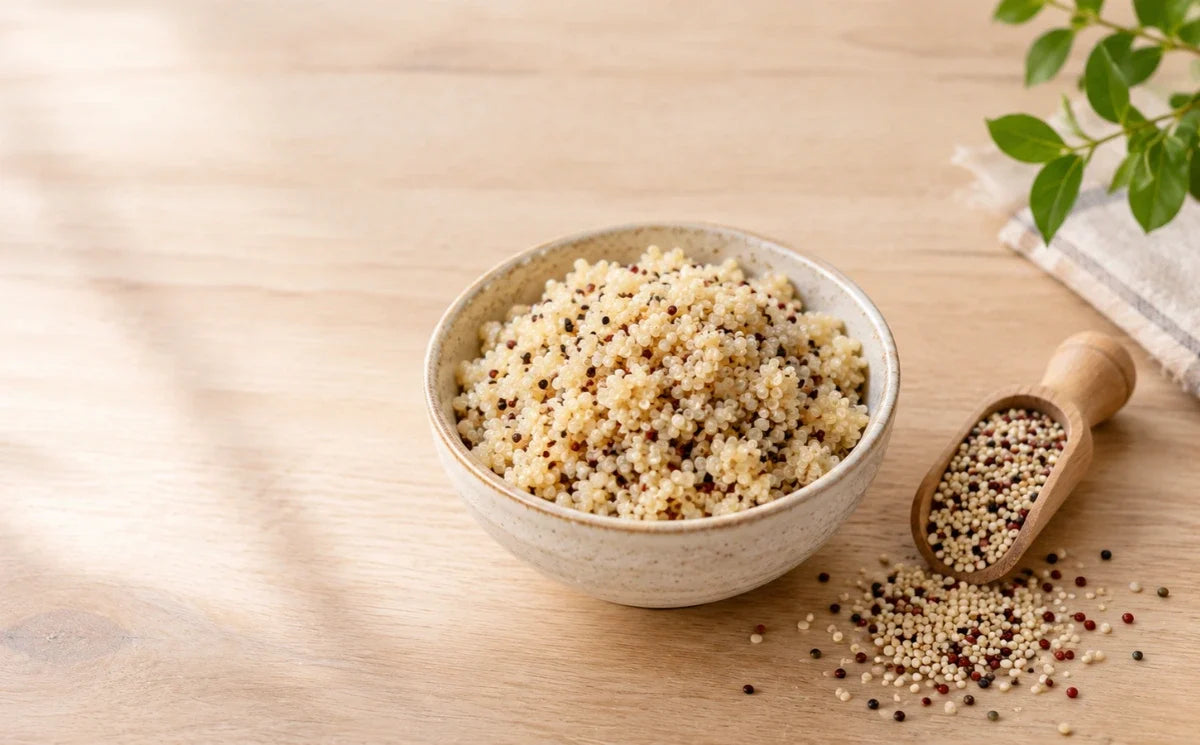
Quinoa sits in the grain aisle, cooks like rice and shows up in grain bowls, so it's no surprise people ask: is quinoa a grain or a seed? The short answer is that it's both, depending on whether you're asking a botanist or a cook. This guide clears up the confusion, explains what a pseudocereal is, and answers the other questions beginners ask most: is quinoa gluten-free, is it a complete protein, and how does it compare with rice?
Quick Answer
Quinoa is technically a seed, from the plant Chenopodium quinoa, not a true cereal grain. It's called a pseudocereal because it's cooked and eaten like a grain but doesn't grow on grass like wheat, rice or oats. In the kitchen and on the nutrition label, it's treated as a whole grain, and the Whole Grains Council counts it as one. Quinoa is naturally gluten-free and is a complete protein, meaning it contains all nine essential amino acids.
Is Quinoa a Grain or a Seed?
Both answers are right, because the two words mean different things.
- Botanically: quinoa is the seed of a flowering plant. True cereal grains, such as wheat, rice, oats, barley and corn, are the seeds of grasses. Quinoa doesn't grow on grass, so it isn't a true cereal.
- Culinary and nutritional: a "grain" is anything we cook and eat like a grain. Quinoa is prepared like rice, has a similar role on the plate and is rich in starch, so it's used as a grain. Nutritionally, it's counted as a whole grain by the Whole Grains Council.
So if someone asks "is quinoa technically a grain?", the accurate answer is: technically a seed, but used and counted as a whole grain.
What Does "Pseudocereal" Mean?
"Pseudo" means "false," and "cereal" refers to grasses grown for their grain. A pseudocereal is a plant that produces starchy seeds used like cereal grains, but that isn't a grass. The best-known examples are:
- Quinoa
- Amaranth
- Buckwheat (despite the name, it isn't related to wheat)
Pseudocereals are popular because they're naturally gluten-free and often have more protein, minerals and antioxidants than many true cereals. Quinoa is closely related to plants such as spinach and beets, not to wheat or rice.
Why Is Quinoa Called a Grain If It's a Seed?
Because "grain" is mostly a food category, not a botanical one. Quinoa:
- Is cooked in water until the seeds soften and unfurl, just like rice
- Is served in the same role as rice or couscous (bowls, pilafs, salads, porridge)
- Is sold in the grain aisle and counted among whole grains
- Provides starch and fiber like other whole grains
Every grain is technically a seed, but not every seed is called a grain. Quinoa just happens to be a seed that cooks and eats like one.
Is Quinoa Gluten-Free?
Yes. Quinoa is naturally gluten-free, which is why it's a popular grain substitute for people with celiac disease or gluten sensitivity. Remember that "naturally gluten-free" doesn't guarantee a package is gluten-free: quinoa can be cross-contaminated with wheat, barley or rye during growing, harvesting or packaging. If you have celiac disease, look for a product with a gluten-free certification or claim on the label. For other naturally gluten-free options, see which ancient grains are gluten-free.
Is Quinoa a Complete Protein?
Yes. Quinoa contains all nine essential amino acids, the ones your body can't make, and it's particularly high in lysine, which most plant foods lack. That's unusual for a plant food, and it's one reason quinoa is so popular with vegetarians and vegans. Per 100 g of cooked quinoa, Healthline lists about 4.4 g of protein, along with 2.8 g of fiber and around 120 calories.
Keep it in perspective: quinoa is a good source of protein, but it isn't a high-protein food in the way meat, tofu or lentils are, so it's best as part of a varied diet.
How Is Quinoa Different From Rice Nutritionally?
Quinoa and rice are both useful staples, and the differences are more about nutrients than calories. From our full quinoa vs rice comparison:
|
Per ½ cup cooked |
Quinoa |
Brown rice |
|
Calories |
About 110 |
About 110 |
|
Carbohydrates |
About 20 g |
About 22 g |
|
Protein |
About 4 g |
Lower |
|
Fiber |
About 2.5 g |
Roughly 20 to 30% less |
|
Iron and magnesium |
Higher |
Lower |
|
Selenium and manganese |
Lower |
Higher |
- Protein and amino acids: quinoa is a complete protein, while rice generally is not.
- Fiber: Healthline notes that quinoa has more fiber than brown rice.
- Glycemic index: quinoa's is about 53, which is considered relatively low.
- Taste and texture: quinoa is light, slightly nutty and fluffy, while brown rice is chewier.
- Gluten: both are naturally gluten-free.
Is Quinoa Healthier Than Rice?
Quinoa generally has the edge on protein, fiber, iron and magnesium, but brown rice offers more selenium and manganese, and both are healthy. The best choice depends on your goals, and variety is a good strategy. Read the full comparison in our guide to quinoa vs rice, and see our guide to the health benefits of brown rice and white rice if you're choosing between rice types.
Quinoa vs Other Pseudocereals and Whole Grains
| Feature |
Quinoa |
Amaranth |
Buckwheat |
Brown rice |
|
Type |
Pseudocereal (seed) |
Pseudocereal (seed) |
Pseudocereal (seed) |
True cereal grain |
|
Gluten-free |
Naturally |
Naturally |
Naturally |
Naturally |
|
Texture when cooked |
Light, fluffy, slightly crunchy germ |
Sticky, porridge-like |
Earthy, soft |
Chewy |
If you're after more variety, SFMart's organic small grains collection includes organic quinoa and multicolor quinoa, alongside millet, farro, rye and other grains.
Does It Matter Whether Quinoa Is a Grain or a Seed?
For cooking, no. For a few situations, a little:
- Gluten-free diets: being a pseudocereal means quinoa doesn't contain the gluten proteins found in wheat, barley and rye.
- Nutrition labels and menus: quinoa is generally counted as a whole grain.
- Allergies and sensitivities: quinoa is a seed, so people with specific seed or pseudocereal sensitivities should check with their doctor.
- Cooking: treat it like a grain: rinse, simmer and fluff.
Quick Tips for Cooking Quinoa
- Rinse it first. Quinoa has a natural coating of bitter compounds called saponins that protect the seed from insects. Rinsing or soaking removes most of them and prevents a bitter or soapy taste.
- Simmer, don't boil hard. Cook it covered until the water is absorbed, then let it rest and fluff with a fork. As a rule of thumb, use roughly twice as much water as quinoa, and check your package for exact timing.
- Soaking and rinsing also reduce phytates and oxalates, which can interfere with mineral absorption and may matter for people prone to kidney stones.
- Mix it up. Combine quinoa with other grains. Our guide to Korean multi-grain rice mix shows how, and the organic mixed grain collection has ready-made blends.
- Compare other grains. See how barley differs in our guide to hulled vs pearl barley.
Final Thoughts
Quinoa is a seed that cooks like a grain: a pseudocereal that's naturally gluten-free, a complete protein, and easy to use in place of rice or other grains. Don't let the label confuse you. Rinse it, cook it, and enjoy it as part of a varied, whole-grain diet.
Ready to try it? Browse SFMart's organic small grains, organic quinoa and organic mixed grain collections.


