
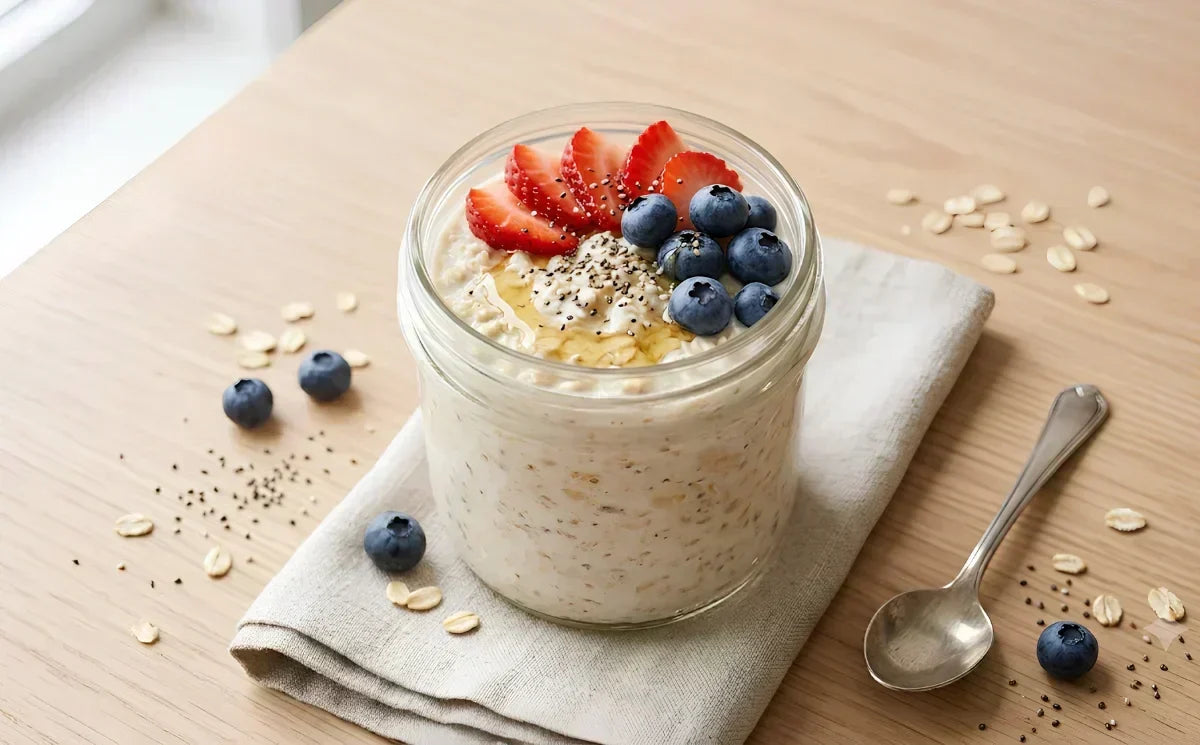
Overnight oats sound foolproof: combine oats and liquid, put it in the fridge, and wake up to a ready-to-eat breakfast. In practice, a lot of people end up with a bowl that's either gluey and mushy or oddly dry and undercooked, and the difference almost always comes down to a handful of details that recipe cards tend to skip over.
This guide covers the actual ratios, the right oat type, common texture problems and enough variations that you won't get bored making the same bowl five days in a row.
What Are Overnight Oats, Exactly?
Overnight oats are raw oats soaked in a liquid, usually milk or a milk alternative, along with other ingredients like yogurt or chia seeds, then left in the refrigerator for several hours (usually overnight, hence the name) so the oats soften without any cooking involved. The soaking process is what breaks down the oats and thickens the mixture, rather than heat, which is the key difference from stovetop or microwave oatmeal.
Because there's no cooking step, overnight oats are one of the easiest meal-prep breakfasts to batch out for the week, but the trade-off is that getting the texture right depends entirely on ratio and oat type, since there's no opportunity to adjust consistency with more heat or more liquid partway through, the way you can with a pot on the stove. Choosing the right oats is essential in getting the perfect overnight oats, and understanding groat oats nutrition can help you pick the best base for your bowl. SFMart has a diverse range of staples like organic grains, oats, flours and more that you can pick from.
Overnight Oats Ratio: The Number That Actually Matters
The single most important detail in any overnight oats recipe is the liquid-to-oats ratio, and it's also the detail most commonly gotten wrong.
The standard ratio is 1:1, equal parts rolled oats and liquid, for example, 1/2 cup rolled oats to 1/2 cup milk. This produces a thick, spoonable, classic overnight oats texture after soaking.
Some recipes call for slightly more liquid, up to 1:1.25, particularly if you're adding thick mix-ins like Greek yogurt, mashed banana, or a lot of chia seeds, all of which absorb additional liquid as they sit. If your base recipe already includes a couple of tablespoons of yogurt, you may need slightly less added milk to compensate, or the final texture can turn out looser than expected.
A common mistake is using the ratio meant for stovetop oatmeal (often closer to 1:2, oats to water) for overnight oats. Since there's no heat or evaporation involved in the overnight method, a 1:2 ratio typically produces a soupy, overly loose bowl rather than the thick, pudding-like texture people expect.
Overnight Oats Liquid to Oats Ratio: Adjusting for Your Preferred Consistency
Once you have the 1:1 baseline down, you can adjust from there based on how you like your oats:
- Thicker, more scoopable texture:
Use a slightly smaller liquid ratio, closer to 3/4 cup liquid per 1 cup of oats
- Looser, more pourable texture:
Use slightly more liquid, up to 1.25 cups liquid per 1 cup of oats
- If using a thicker milk alternative (like a full-fat coconut milk):
You may need slightly more liquid than with regular dairy milk or a thinner milk alternative, since thicker liquids don't fully hydrate the oats in the same way
It's worth making a batch at the standard 1:1 ratio first, tasting the texture after a full overnight soak, and then adjusting up or down slightly the next time you make it, since personal preference on thickness varies quite a bit from one person to the next.
Best Oats for Overnight Oats Texture
Not every oat type works equally well for the overnight, no-cook method, and this is one of the most searched questions on the topic for good reason.
Rolled (old-fashioned) oats are the standard, most reliable choice for overnight oats. Rolled oats are flatter, thinner structure absorbs liquid efficiently over several hours without any heat, softening to a pleasant, slightly chewy texture that most people associate with "good" overnight oats.
Quick oats also work, though the texture ends up notably softer and less textured, closer to a smooth pudding than a bowl with distinct oat pieces. This can be a plus if you prefer a very soft texture, or a downside if you want more bite.
Steel cut oats are the trickiest option for the traditional overnight method, which is covered in detail in the next section, since their denser structure doesn't fully soften through soaking alone the way rolled oats do.
Instant oats are generally not recommended for overnight oats, since they're processed to soften almost immediately, which tends to produce an overly mushy, paste-like texture after a full night of soaking, well past the texture most people are looking for.
Can You Use Steel Cut Oats for Overnight Oats?
This comes up constantly, and the honest answer is: technically yes, but with a significant caveat. Steel cut oats are chopped, not flattened, which means they retain much more of their original structure and don't absorb liquid nearly as efficiently as rolled oats do without heat.
If you soak steel cut oats overnight using the same method and ratio as rolled oats, you'll likely end up with oats that are still fairly firm and chewy, sometimes described as undercooked, rather than the soft, creamy texture associated with rolled oat; overnight oats. If you wish to learn the difference between steel cut oats and rolled oats, you might want to consider reading this well-curated blog that SFMart has compiled for you.
A few ways to make steel cut oats work for an overnight, no-cook style prep:
- Use a longer soak time, ideally 24 to 48 hours rather than just overnight, to allow more time for the denser groat pieces to soften
- Use warm (not hot) liquid rather than cold when combining the ingredients, which can slightly speed up softening
- Accept and even embrace the chewier, more textured result rather than expecting the same softness as rolled oats, since steel cut overnight oats will have a distinctly different, heartier bite even after a long soak
Alternatively, some people "half-cook" steel cut oats by briefly simmering them for 5 to 10 minutes (well short of the full 20 to 30 minute stovetop cook time) before combining with liquid and refrigerating overnight. This hybrid approach produces a texture closer to what people expect from overnight oats while still using steel cut oats as the base, since the brief cooking jump-starts the softening process that soaking alone struggles to fully achieve.
If a true no-cook, dump-and-go overnight oats recipe is the goal, rolled oats remain the more dependable choice. Steel cut oats are workable, but require either a longer lead time or a brief pre-cook step to reach a similar texture.
Rolled Oats vs Steel Cut for Overnight Oats: Quick Comparison
|
Factor |
Rolled Oats |
Steel Cut Oats |
|
Softens fully overnight |
Yes |
Not fully, without extra steps |
|
Texture after soaking |
Soft, creamy, classic overnight oats consistency |
Chewy, firmer, more distinct pieces |
|
Best soak time |
6-8 hours (standard overnight) |
24-48 hours, or a brief pre-cook |
|
Beginner-friendly |
Yes |
Requires more planning |
|
Glycemic index |
Moderate |
Lower |
If texture predictability and convenience matter most, rolled oats win clearly. If you specifically want the lower glycemic index and heartier texture of steel cut oats and don't mind a longer lead time or an extra step, they're a workable, if less common, option for overnight prep.
SFMart’s range of organic oats is a purchase you would not want to miss. If you want to know how regular oats differ from organic oats, read this blog curated for you.
Why Are My Overnight Oats Mushy?
This is one of the most common complaints, and it almost always comes down to one or two specific causes.
Too much liquid relative to oats:
As covered above, using a ratio closer to stovetop oatmeal (1:2) rather than the standard overnight ratio (roughly 1:1) is the single most common cause of an overly mushy, soupy result.
Using quick oats or instant oats instead of rolled oats:
Both are processed to soften much faster than rolled oats, which can push the texture past "soft" into "mushy" territory after a full overnight soak, since they were never designed to sit in liquid for 6 to 8 hours unheated.
Soaking for too long:
While overnight oats are meant to sit for several hours, oats left for multiple days (beyond about 4 to 5 days total) can continue to soften and break down further, eventually turning notably softer and less appealing than a fresh batch.
Too many liquid-heavy mix-ins:
Ingredients like a large amount of mashed banana, a very wet fruit puree, or excess yogurt add liquid content beyond what the recipe's base ratio accounts for, which can tip an otherwise correctly measured recipe into an overly soft result.
If your overnight oats consistently turn out mushy, the fix is almost always reducing the liquid slightly, switching to rolled oats if you're currently using quick or instant, and being mindful of extra-wet mix-ins pushing the ratio out of balance.
Overnight Oats Not Getting Soft Enough
The opposite problem, oats staying too firm or slightly crunchy, usually points to a different, equally specific cause.
Not enough liquid. If the oats look dry or you can still see distinct, hard oat flakes rather than a cohesive, thickened mixture after a full night, the ratio likely needs more liquid, closer to the 1:1 standard or slightly above it.
Using steel cut oats without adjusting the method. As covered above, steel cut oats need either a much longer soak (24-48 hours) or a brief pre-cook to soften adequately, since a standard overnight soak isn't enough time for their denser structure.
Cold liquid straight from the fridge. While overnight oats don't require heat, starting with room-temperature liquid rather than very cold liquid can help the softening process along slightly, particularly in the first couple of hours before the mixture goes into the fridge.
Not enough soak time. A full 6 to 8 hours is generally the minimum for rolled oats to soften properly. A shorter soak, say 2 to 3 hours, often isn't enough time, even with a correct ratio.
Easy Overnight Oats: A Basic Recipe to Start From
Ingredients (makes 1 serving):
- 1/2 cup rolled oats
- 1/2 cup milk or milk alternative
- 1/4 cup Greek yogurt (optional, for extra protein and creaminess)
- 1 tablespoon chia seeds (optional, adds fiber and helps thicken)
- 1 teaspoon honey or maple syrup, to taste
- A pinch of cinnamon
Instructions:
- Combine all ingredients in a jar or container with a lid.
- Stir well, making sure the oats are fully submerged in liquid.
- Cover and refrigerate for at least 6 hours, or overnight.
- In the morning, stir again and add fresh toppings like berries, sliced banana, or a spoonful of nut butter.
This base recipe is intentionally simple so it's easy to scale up for meal prep or adjust based on the flavor variations below.
High Protein Overnight Oats
Plain overnight oats are moderate in protein, but not high, so if you're building a more protein-forward breakfast, a few additions consistently work well:
- Greek yogurt: Adds roughly 15-20 grams of protein per cup and also contributes to a creamier texture, doing double duty in the recipe
- Protein powder: Stir in a scoop (whey, casein, or a plant-based option) for an additional 20-25 grams of protein, though it's worth adding it gradually and tasting, since some protein powders can make the texture slightly gummier if overused
- Cottage cheese: A less common but increasingly popular addition, cottage cheese blends into a smooth, protein-rich base while contributing a milder flavor than a heavily flavored protein powder
- Nut butter: Adds a moderate amount of protein along with healthy fat, which further supports fullness on top of the fiber already present in the oats
A well-built high protein version, oats, milk, Greek yogurt, and a spoonful of nut butter, can reasonably reach 25 to 30 grams of protein in a single serving, a meaningful jump from the 5 or so grams in a plain, unadorned bowl.
Meal Prep Overnight Oats: Making a Week's Worth at Once
One of the biggest advantages of overnight oats is how well they scale for weekly meal prep, but a few adjustments make batch-prepping smoother:
Use wide-mouth jars or containers rather than narrow ones, which makes stirring and adding toppings each morning easier.
Prep the base separately from toppings that don't hold up well over several days. Fresh berries, sliced bananas, and granola are best added the morning of eating, rather than mixed in five days ahead, since they can turn mushy or lose crunch sitting in liquid for that long.
Make in batches of 4 to 5 days rather than a full week, since oats can continue softening well past that window, eventually shifting from "soft" to noticeably overly soft or slightly separated in texture.
Label with the date prepared, a small habit that helps avoid accidentally eating a batch that's been sitting longer than intended, since overnight oats don't always show obvious signs of being past their best days the way some foods do.
If you wish to learn more about The Healthiest Type of Oats, read this blog which breaks down how steel cut, rolled, and other oat types compare nutritionally if you're deciding which oat to build your overnight oats around in the first place.
Overnight Oats Recipe Variations Worth Trying
Once the base ratio and method are dialed in, it's easy to rotate flavors so the same breakfast doesn't get repetitive:
Apple cinnamon: Diced apple, a dash of cinnamon, and a small drizzle of maple syrup, added either the night before (softening slightly by morning) or fresh the next day for more crunch.
Peanut butter banana: Mashed banana mixed into the base, topped with a spoonful of peanut butter and a few banana slices in the morning.
Chocolate protein: A spoonful of cocoa powder and a scoop of chocolate protein powder stirred into the base, topped with a few chocolate chips or sliced strawberries.
Pumpkin spice: A couple of tablespoons of pumpkin puree and pumpkin pie spice mixed in, a popular seasonal variation that adds fiber from the pumpkin along with the oats.
Savory version: A less common but increasingly popular approach, oats soaked in unsweetened milk or a savory broth-based liquid, topped in the morning with a soft-boiled egg, avocado, and a pinch of salt, skipping the usual sweet flavor profile entirely.
The Bottom Line
Overnight oats are genuinely one of the simplest make-ahead breakfasts available, but the results only turn out well when the ratio and oat type match the method. Rolled oats at roughly a 1:1 liquid-to-oats ratio is the most reliable starting point for most people. Steel cut oats can work, but need either a longer soak or a brief pre-cook to soften properly, since their denser structure doesn't fully hydrate through soaking alone the way rolled oats do. From there, protein additions like Greek yogurt or protein powder, along with rotating flavor variations, keep a simple base recipe from getting repetitive across a week of meal prep.
If you're building overnight oats specifically with weight management or fullness in mind, it's worth reading through Oats for Weight Loss, which goes deeper into fiber, glycemic index, and portion size for anyone using oats as part of a broader fat loss approach.
Since overnight oats are ultimately a whole grain soaked and softened rather than cooked, the same principle that makes a good bowl of oats work, choosing a minimally processed, good-quality base ingredient, applies just as much to other pantry staples used in make-ahead meals, whether that's a batch of soaked whole grains, lentils, or beans prepped for the week alongside your morning oats.


