
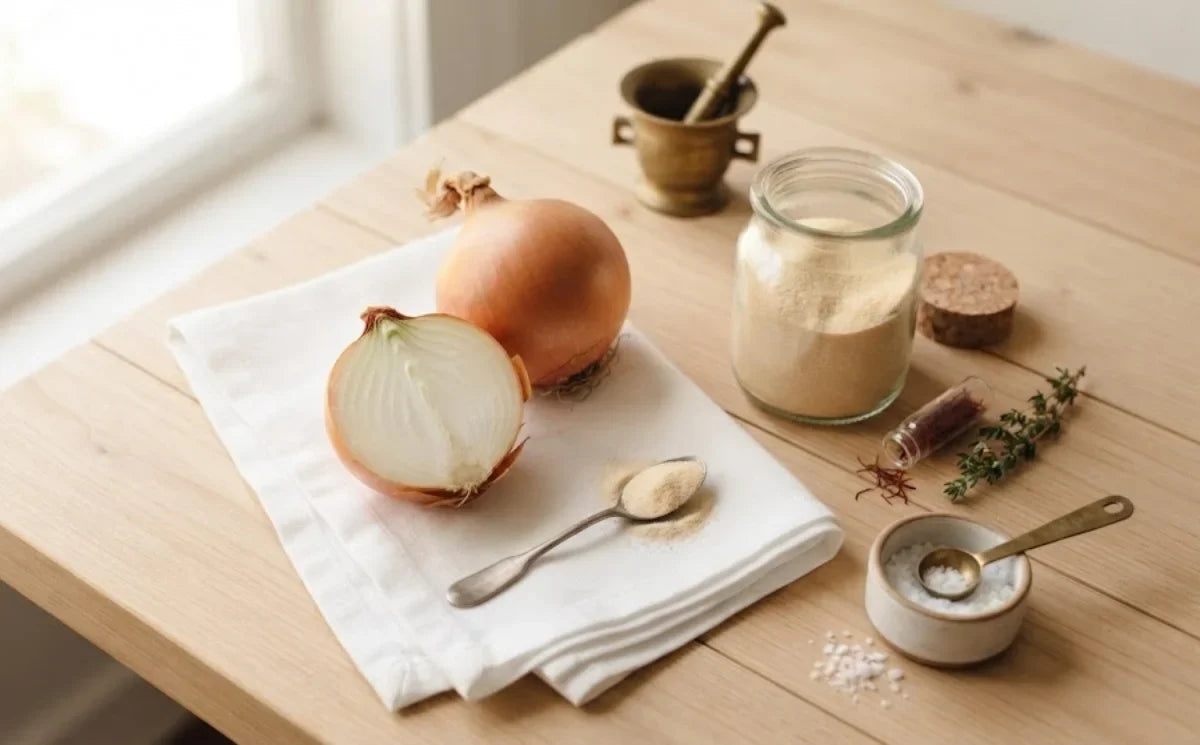
Running out of fresh onion mid-recipe is one of those small kitchen moments that shouldn't derail dinner, and in most cases, it genuinely doesn't, as long as you know the right substitution ratio. Onion powder and fresh onion aren't interchangeable one-for-one, but understanding exactly how they differ, in strength, moisture, and where each one actually performs better, makes swapping between them far less of a guessing game.
At SFMart, onion powder is one of our steadiest-selling pantry staples, so it's worth breaking down the real substitution math and when reaching for the jar genuinely beats chopping a fresh onion.
Quick Answer
The standard substitution ratio is roughly 1 teaspoon of onion powder for every ¼ cup of chopped fresh onion, or about 1 tablespoon of onion powder to replace one medium fresh onion. This works because onion powder is dehydrated and concentrated, fresh onion is around 89% water, so a small amount of powder delivers a similarly strong flavor punch without the bulk or moisture.
Onion powder is the better choice in dry rubs, soups, sauces, and anything simmered long enough for flavor to develop evenly. Fresh onion remains the better choice anywhere texture, crunch, or moisture matters, salads, salsas, and anything served raw, since powder can't replicate what a physical piece of onion actually does in those dishes.
Onion Powder Substitution Ratio: The Standard Conversion
The most widely used conversion, consistent across major cooking references, is 1 teaspoon of onion powder for every ¼ cup of finely chopped fresh onion. Scaled up, that generally works out to about 1 tablespoon of onion powder replacing one medium whole onion, though this varies a little depending on the onion's size and how finely it's chopped.
The reason such a small amount of powder does the job is concentration: dehydration removes virtually all of the onion's water content, leaving the flavor compounds behind in a much smaller volume. Using powder and fresh onion in equal volumes will almost always overpower a dish, so it's worth measuring rather than eyeballing it, especially the first few times.
How Much Onion Powder Equals One Onion?
For a standard medium onion, roughly 1 tablespoon of onion powder is a reasonable starting point, though it's worth adjusting to taste rather than treating it as an exact science. Larger onions will need slightly more, smaller ones slightly less, and the type of dish matters too: a slow-simmered stew has more time for the powder's flavor to bloom and distribute, while a quick sauté might need a touch more to compensate for the shorter cooking window.
Why the Ratio Isn't Always 1:1
A few factors explain why this conversion isn't as simple as a straight volume swap:
- Moisture content. Fresh onion is roughly 89% water. Onion powder has essentially none, so substituting powder for fresh onion in a recipe that relies on that moisture, a sauce or a braise, for example, may need a small liquid adjustment to compensate.
- Concentration. Because the dehydration process removes water while keeping the flavor compounds intact, onion powder is considerably more concentrated by volume than the equivalent amount of fresh onion, which is exactly why the ratio favors powder so heavily. The same drying-driven concentration effect shows up across dried herbs generally, which we break down in Fresh vs Dried Herbs: Why Yours Taste "Dusty".
- Texture. Powder dissolves into a dish; it can't provide the bite, crunch, or visual presence that chopped or sliced fresh onion contributes, which matters enormously in raw or lightly cooked applications.
Is Onion Powder as Healthy as Fresh Onion?
Nutritionally, the two aren't a straightforward like-for-like comparison, mostly because of how concentrated the powder is. Per typical serving size, fresh onion brings more water content and vitamin C, some of which is reduced during the dehydration process. Onion powder, used in the small quantities a recipe actually calls for, still contributes meaningful amounts of potassium, calcium, and fiber relative to its size, along with a good share of the same beneficial plant compounds, including quercetin, an antioxidant that holds up reasonably well through drying.
In practical terms, since you're using such a small amount of powder compared to a much larger volume of fresh onion, the real-world nutritional difference in a finished dish is generally minor. Neither is a health upgrade over the other so much as a different form of the same core ingredient, and both bring real value to a varied diet, similar to how organic spices generally contribute more than just flavor to a dish.
Organic Onion Powder Benefits
Choosing organic onion powder specifically adds a layer worth understanding beyond the growing method alone (our broader look at Organic Herbs vs. Inorganic Herbs: Which is Better? covers how this plays out across the whole herb and spice aisle). Conventional spices, onion powder included, are commonly sterilized using ethylene oxide fumigation or irradiation before sale, both of which are prohibited under USDA organic standards. Organic onion powder is also more likely to be made without synthetic anti-caking agents, ingredients many conventional brands add to keep the powder free-flowing on a shelf.
That's a genuine tradeoff worth knowing: organic onion powder can clump more readily than a heavily processed conventional jar, precisely because it's missing those additives, not because it's lower quality. We go into this in more detail, including why clumping is actually a purity signal rather than a flaw, in our guide on why organic garlic and onion powder clump, and our broader guide on whether organic spices are really irradiation-free covers the processing question in full. If you're stocking a clean pantry more broadly, Why McCabe Organic Garlic Powder Should Be a Pantry Essential covers the same additive-free considerations for onion powder's closest pantry cousin.
Onion Powder for Soups and Sauces
This is genuinely where onion powder does its best work. In soups, stews, sauces, gravies, and braises, texture isn't the point, flavor is, and powder dissolves seamlessly into the liquid without leaving behind fibrous pieces or requiring a sauté step first.
It's also a reliable option for dry rubs, marinades, and spice blends, where fresh onion's moisture would actively work against the mix's shelf life and texture. Because it disperses evenly, onion powder tends to give a more uniform flavor throughout a dish than unevenly distributed pieces of fresh onion might, particularly useful in a smooth sauce or a blended soup.
When Fresh Onion Is Still the Better Choice
Powder has real limits, and they're worth respecting rather than working around. Anywhere a dish depends on genuine crunch or bite, salads, salsas, slaws, or a raw garnish, fresh onion is simply the right tool, since powder contributes flavor but nothing structural. Caramelized onions, French onion soup's base, or any dish where onion is meant to visually and texturally hold its own also call for the real thing. As a rough rule: if a recipe would still work with the onion diced small and cooked down, powder is a reasonable stand-in; if the onion needs to be seen, bitten into, or provide actual volume, reach for fresh.
Does Onion Powder Go Bad?
Not in the way fresh onion spoils, but it does lose potency over time. Properly stored in an airtight container away from heat, light, and moisture, onion powder generally holds good flavor for around 2 to 3 years, considerably longer than a fresh onion's typical few weeks at room temperature. It doesn't become unsafe to eat much beyond that window, it simply grows weaker and less aromatic, so a smell test, rubbing a small amount between your fingers and checking for a genuine onion aroma, is a more reliable freshness check than a printed date alone.
If you notice clumping, that's a moisture issue rather than spoilage, and it's easily fixed by breaking the powder apart, as covered in our guide above on why garlic and onion powder clump. For dried pantry goods more broadly, How to Store Dried Vegetables So They Never Go Moldy walks through the same moisture-control principles.
Final Thoughts
Onion powder and fresh onion aren't rivals so much as two different tools suited to different jobs. Powder wins on convenience, shelf life, and consistency in cooked, blended dishes, while fresh onion remains irreplaceable anywhere texture and bite genuinely matter. Knowing the roughly 1 tablespoon-per-onion ratio takes the guesswork out of swapping between them, whichever direction you're going.
If you're stocking your pantry with a genuinely clean onion powder, SFMart's organic onion powder is USDA and CCOF certified with no additives, and our broader organic herbs and spices collection covers the rest of your everyday seasoning shelf.


