
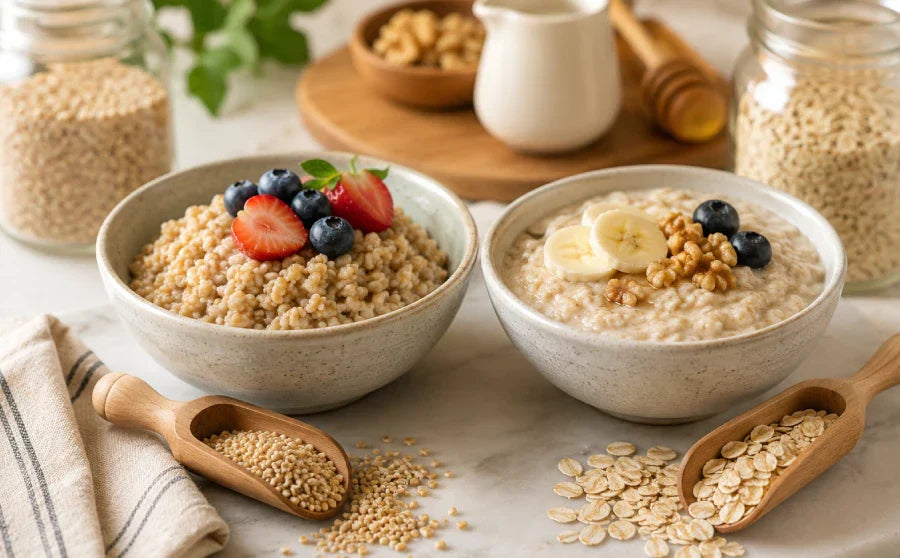
If you've stood in the oatmeal aisle wondering why there are three or four different kinds of "oats" that all seem to do the same job, you're not alone. Steel cut oats, rolled oats, quick oats, instant oats: they all come from the same oat groat, yet they cook differently, taste differently, and even affect your blood sugar differently.
A hot, steaming bowl of organic oats usually comes to mind when you think of a healthy way to start your day. They taste delicious, keep you full for a long time, and are a great addition if you're trying to lose or watch your weight. But one common mistake people make is grabbing the wrong variety for their needs, and with several types of organic oats on the shelf (thick rolled, regular rolled, steel-cut, and whole oat groats), it helps to understand how the two most popular varieties, steel-cut and rolled, actually compare.
This guide breaks down steel cut oats vs rolled oats in plain terms: how they're made, how they compare nutritionally, which one is better for weight loss or diabetes management, and how to swap one for the other if you're mid-recipe and only have one on hand. You might want to read till the end to benefit from SFMart’s diverse range of oats.
What Are Regular Oats?
Before comparing the two, it helps to know where both start. Every type of oat you'll find at the store (steel cut, rolled, quick, or instant) begins as the same whole grain: the oat groat. This is the oat kernel after the inedible outer hull has been removed, but before any further processing happens. The groat is a whole grain in its purest, least-processed form, and it's technically what you'd cook if you wanted the chewiest, longest-cooking oatmeal possible.
The differences between steel cut and rolled oats come entirely from what happens to that groat after harvesting.
What Are Steel Cut Oats?
Steel cut oats (sometimes labeled "Irish oats," "pinhead oats," or "coarse oats") are made by taking the whole oat groat and chopping it into two or three pieces with a steel blade. That's it: no steaming, no flattening, no pre-cooking. The result looks a bit like coarse, chopped rice or small pebbles rather than flakes.
Because the groat is barely disturbed, steel cut oats retain more of their original structure. This is a big part of why they take longer to cook and why they have a denser, chewier bite with a more robust, nuttier flavor compared to rolled oats. Their average cook time runs 15–30 minutes, though soaking them in water beforehand can cut that down.
What Are Rolled Oats?
Rolled oats (also called "old fashioned oats") go through an extra couple of steps. The oat groats are first steamed to soften them, then pressed flat between large rollers. This flattening process is what gives rolled oats their familiar flake shape.
Steaming and rolling break down some of the oat's cell structure, which is why rolled oats cook faster (usually just 2–10 minutes) and turn creamier than steel cut oats. Quick oats and instant oats are simply rolled oats that have been steamed longer and rolled thinner (or pre-cooked and dehydrated, in the case of instant oats), which is why they cook in a couple of minutes but also turn mushier and lose some texture.
Steel Cut Oats vs Rolled Oats: Side by Side
|
Factor |
Steel Cut Oats |
Rolled Oats (Old Fashioned) |
|
Processing |
Groat chopped into pieces |
Groat steamed and flattened |
|
Texture |
Chewy, dense, slightly crunchy |
Soft, creamy, familiar oatmeal texture |
|
Cook time (stovetop) |
20–30 minutes |
5–10 minutes |
|
Glycemic index |
Lower (roughly 42–52) |
Moderate (roughly 55–63) |
|
Best for |
Overnight oats, savory bowls, meal prep |
Quick breakfasts, baking, granola |
|
Calories per 1/4 cup dry |
~150 |
~150 |
|
Fiber content |
Slightly higher per serving due to less surface area exposure |
Slightly lower, but still substantial |
Nutritionally, steel cut and rolled oats are nearly identical when compared at equal dry weights. For reference, a 40-gram serving of each contains:
Steel Cut Oats:
- Protein: 5g
- Calories: 150
- Fat: 2.5g
- Fiber: 4g
- Carbohydrate: 27g
- Sugar: 0g
Rolled Oats:
- Protein: 5g
- Calories: 140
- Fat: 2.5g
- Fiber: 4g
- Carbohydrate: 27g
- Sugar: 0g
Both are whole grains, both are naturally gluten-free (as long as they're processed in a dedicated facility), and both deliver a solid dose of beta-glucan fiber, the type of soluble fiber oats are famous for. The real differences show up in texture, cook time, and how your body digests them.
Benefits of Steel Cut and Rolled Oats
High in Beta-Glucan Fiber
Organic whole oat groats are rich in fiber, particularly beta-glucan, which supports healthy digestion and can help lower cholesterol and heart disease risk. Steel-cut oats are less processed than rolled oats, so they carry a slightly higher fiber content, though the actual variation between the two is small.
Steel Cut Oats Benefits
- Lower glycemic response: Larger, less-processed groat pieces take longer to break down, slowing glucose release into your bloodstream.
- Longer satiety: The denser structure digests more slowly, which many people find keeps them fuller for longer.
- More texture, less processing: For anyone trying to eat closer to the whole, unprocessed form of a grain, steel cut oats are about as minimally processed as oatmeal gets.
- Versatility beyond sweet breakfasts: Their chewy, rice-like texture holds up well in savory preparations: think oats cooked in broth with sautéed vegetables, similar to how you'd use a pot of organic brown rice or another whole grain as a savory base.
Rolled Oats Benefits
- Faster, more convenient: A 5-to-10-minute cook time is a real advantage on busy mornings.
- Creamier texture: If you like a smooth, classic oatmeal consistency, rolled oats deliver that in a way steel cut oats simply can't.
- Better for baking: Cookies, granola bars, muffins, and crumble toppings almost always call for rolled oats because they absorb moisture and bind more evenly.
- Still nutrient-dense: Rolled oats retain the bran and germ of the oat groat, so you're still getting fiber, protein, iron, magnesium, and B vitamins. The idea that rolled oats are "unhealthy" compared to steel cut is largely overstated: the fiber and micronutrient content per dry serving is very close between the two.
Glycemic Index: Steel Cut Oats vs Rolled Oats
This is one of the most searched comparisons, and for good reason if you're managing blood sugar. Glycemic index (GI) measures how quickly a food raises blood glucose, on a scale up to 100.
- Steel cut oats: roughly 42–55, depending on cook time and preparation
- Old fashioned rolled oats: roughly 55–63
- Quick oats: roughly 65–75
- Instant oats (flavored packets): can climb to 79 or higher, especially with added sugar
The pattern is consistent: the less an oat is processed, the lower its glycemic impact tends to be, since more intact starch structures take longer to digest. Cooking method matters too: oats cooked briefly and left slightly firm (al dente, essentially) tend to have a lower GI than oats simmered into a soft mush.
Steel Cut Oats vs Rolled Oats for Diabetics
If you're managing type 2 diabetes or prediabetes, this comparison isn't just academic. Steel cut oats are generally the better choice for blood sugar management because of their lower glycemic index and slower digestion. That said, rolled oats aren't off-limits: portion size, toppings, and pairing matter just as much as the type of oat.
A few practical tips that apply to both:
- Pair oats with a protein or healthy fat (nuts, seeds, nut butter, or a boiled egg on the side) to further slow glucose absorption.
- Avoid instant, flavored oatmeal packets, which often contain added sugar and have a much higher glycemic load.
- Cook oats just until tender rather than overcooking them into a very soft, mushy texture.
- Watch portion size: even a lower-GI food can raise blood sugar if the serving is too large.
If you're managing diabetes, this article is meant as general nutrition information, not personalized medical advice; it's worth talking to a doctor or registered dietitian about how oats specifically fit into your meal plan.
Which Oats Are Better for Weight Loss?
Steel cut oats often get recommended for weight loss, and the logic holds up reasonably well:
- Slower digestion means a more gradual, sustained release of energy, which can help curb mid-morning snacking.
- The chewier texture requires more eating time, which can support portion awareness.
- A lower glycemic response helps avoid the blood sugar spike-and-crash cycle that can trigger hunger shortly after eating.
That said, weight loss ultimately comes down to overall calorie balance, protein intake, and diet quality across the day, not one single food. Rolled oats, prepared with the same portion control and paired with protein (like Greek yogurt or a scoop of nut butter), can absolutely fit into a weight-loss-focused diet too. Both oats are naturally low in fat, cholesterol-free, and a good source of fiber, which supports fullness regardless of which type you choose.
Steel Cut Oats Cook Time (And How to Speed It Up)
Steel cut oats' long cook time is the number one reason people avoid them, but there are a few ways around it:
- Stovetop (traditional): 20–30 minutes, stirring occasionally, with a 4:1 water-to-oats ratio.
- Overnight soak method: Soak the oats in water or milk overnight in the refrigerator, then cook them the next morning in about 10 minutes, since the soaking softens the groat pieces ahead of time.
- Slow cooker: Combine oats and liquid before bed on low heat for 6–8 hours; you'll wake up to a fully cooked, hands-off breakfast.
- Instant Pot / pressure cooker: Around 4–10 minutes at high pressure with a natural release, by far the fastest hands-on method for a true steel cut texture.
- Batch cooking: Make a large pot once a week and refrigerate individual portions; reheat with a splash of milk or water in under 2 minutes.
Can I Substitute Rolled Oats for Steel Cut Oats (Or Vice Versa)?
Yes, but you'll need to adjust liquid and cook time, since the two behave differently in a recipe.
- Substituting rolled oats for steel cut oats: Use the same amount by volume, but reduce the cooking liquid slightly and cut the cook time to about a third of what the steel cut recipe calls for. Expect a softer, less chewy final texture.
- Substituting steel cut oats for rolled oats: This is trickier, especially in baking. Steel cut oats won't absorb liquid or bind the way rolled oats do, so they're a poor 1:1 swap in cookies, granola bars, or muffins. If you want to use steel cut oats in a rolled-oats recipe, pulse them briefly in a food processor first to break them down closer to a rolled-oat consistency, or plan on a noticeably chewier, more rustic result.
- In oatmeal specifically: Either oat works for a basic bowl of oatmeal: the swap mostly changes texture and cook time, not the fundamental outcome. Instant and quick oats are not good substitutes for either in recipes that specify steel cut or rolled, since they're processed to break down much faster and will turn gummy if treated the same way.
Oatmeal Texture: Why It Matters More Than You'd Think
Texture is often the real deciding factor for people choosing between these two oats, more than nutrition numbers. Steel cut oats have a nutty, slightly chewy bite that holds its shape, almost like a cooked grain such as farro or barley. Rolled oats break down into a smoother, creamier bowl that's closer to what most people picture when they think "oatmeal."
Neither texture is objectively better: it comes down to preference and how you plan to use the oats. If you like your morning bowl to have some bite and you're not in a rush, steel cut wins. If you want a soft, spoonable bowl in minutes, rolled oats are the better fit.
For a detailed understanding, browse through SFMart’s organic grains, rice, flours, lentils and beans collection for pantry staples that pair naturally with a bowl of oats.
The Bottom Line
Steel cut oats and rolled oats come from the exact same whole grain: the difference is entirely in how that grain is processed. Steel cut oats are chopped and minimally altered, giving them a lower glycemic index, chewier texture, and longer cook time. Rolled oats are steamed and flattened, cooking faster with a creamier texture, and working better in baked goods.
Neither one is "bad." If you're managing blood sugar or want the slowest-digesting option, reach for a steel cut. If mornings are rushed or you're baking, rolled oats are just as nutritious and far more convenient. Many households simply keep both on hand and use whichever fits the day.
Buy All Varieties of Organic Oats Online at SF Mart
Now that you know the differences between rolled and steel-cut oats, you can add them to your pantry by shopping online at SF Mart. We are one of the top organic food stores, offering a wide variety of certified organic products, including organic barley, organic rice (brown and white), organic beans, organic lentils, and our best-selling organic rolled and steel-cut oats. All products in our online organic food store are USDA & CCOF Certified organic.
Whether you're a regular shopper for organic food or buying for the first time, we're here to help you along the way with certified, attested products you can trust.
Subscribe to our newsletter and get a flat 10 percent discount on our products. Visit the link to learn more about the ongoing promotion, or get in touch with us to explore more of our offerings.
For more on choosing whole grains, lentils, and beans for everyday cooking, see the related guides from SFMart like “Is organic rice good for you?” and “Which rice is best for daily consumption?”.


