
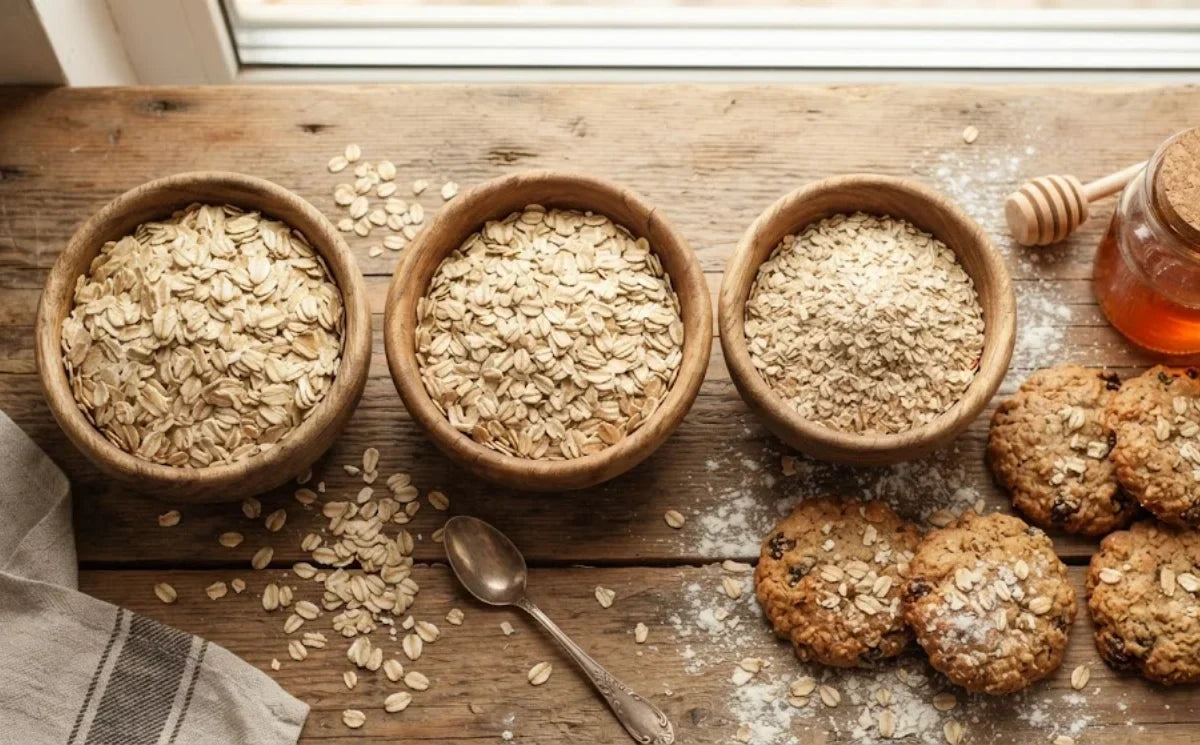
Baking with oats seems simple until a recipe just says "oats" without specifying which kind, and you're standing in the pantry wondering if it actually matters. It does, more than most recipes let on. The type of oat you use changes texture, chew, spread, and how well something like a granola bar holds together, and using the wrong one is behind a lot of common baking complaints, from flat, cakey cookies to granola bars that crumble apart before you even get them out of the pan.
Here's a full breakdown of which oats work best for which baked goods, why thickness matters more than most people realize, and how to fix the most common oat-baking problems. While you are at it, maybe explore and choose your pick from SFMart’s diverse range of products, including Organic Oats, Barley, Teas, Rice and more.
Why Oat Type Actually Matters in Baking
All oats come from the same whole oat groat, but the way that groat is processed, chopped, steamed, rolled thick or thin changes how much liquid it absorbs and how much structure it holds during baking. This matters for two main reasons.
Liquid absorption:
Thicker, less processed oats absorb liquid more slowly and hold their shape better during baking, which affects spread in cookies and binds in bars. Thinner, more processed oats absorb liquid faster and tend to blend more seamlessly into a batter, which is better for some recipes (like muffins) and worse for others (like a chewy cookie that's supposed to have visible oat texture).
Structural integrity:
Baking, unlike cooking oatmeal on the stove, doesn't involve nearly as much added liquid relative to the other ingredients. Since there's less moisture to work with, the oat's original structure matters more, thicker oats hold together as distinct pieces through the bake, while thinner oats can dissolve into the batter more completely, changing the final texture in ways that aren't always desirable.
Thick Rolled Oats vs Regular for Baking
This comparison comes up constantly in baking-specific searches, and it's worth clarifying because regular rolled oats and thick rolled oats (sometimes labeled "old fashioned" versus "thick cut" or "extra thick") aren't quite the same product, even though they're often used interchangeably in casual conversation.
Regular (standard) rolled oats are steamed and rolled to a moderate thickness, the most common oat sold as "old fashioned" oats in most US grocery stores. They work well in most baking applications and are what the majority of cookie, muffin, and granola bar recipes are written around by default.
Thick rolled oats are rolled less thin during processing, retaining more of their original structure and a chewier bite. They hold up noticeably better in recipes where you want distinct, visible oat pieces rather than oats that melt into the batter, chewy cookies and rustic granola being the clearest examples.
For baking purposes specifically:
- Standard rolled oats work well in muffins, quick breads, and any recipe where you want the oats to blend more smoothly into the final texture
- Thick rolled oats are generally preferred for chewy cookies and granola or granola bars, where texture and visible oat pieces are part of the appeal
- The two aren't fully interchangeable 1:1 in every recipe, since thick oats absorb liquid more slowly, a recipe written specifically for thick oats may turn out slightly wetter or less structured if made with standard rolled oats instead, and vice versa
If a recipe doesn't specify which one to use, standard old fashioned rolled oats are the safer default, since they're what most published recipes are tested and written around.
Thick Cut Oats vs Old Fashioned for Cookies
This is essentially the same comparison as above, applied specifically to cookies, and it's worth addressing directly since it's one of the more frequently searched baking questions in this category.
For a classic, soft-but-chewy oatmeal cookie, thick cut oats generally produce a better result. Their sturdier structure holds up through baking, giving the cookie more visible texture and a heartier chew, rather than oats that soften and blend almost entirely into the dough. Old fashioned (standard) rolled oats still work fine and are what most recipes call for by default, but the cookie will read as slightly softer and less texturally distinct compared to one made with thick cut oats.
If you're testing a cookie recipe for the first time and want the chewiest, most textured result, seeking out thick cut or "extra thick" rolled oats specifically, sometimes found in the baking or bulk aisle rather than next to standard instant or quick oats, is worth the small extra effort.
Oatmeal Cookies: Best Oats to Use
Pulling the above comparisons together, here's the practical answer for anyone specifically baking oatmeal cookies:
Best choice: Thick rolled (old fashioned or thick cut) oats. These hold their shape and give the cookie the classic chewy, textured bite most people associate with a good oatmeal cookie.
Workable but not ideal: Standard rolled oats. Still produces a good cookie, just slightly softer and less distinctly textured than one made with thicker oats.
Not recommended: Quick oats as a full substitute. Using quick oats in place of rolled oats in a cookie recipe tends to produce a flatter, denser, less chewy result, since the thinner, more processed oats absorb liquid faster and don't hold their shape as well during baking. This is covered in more detail below.
Not recommended: Instant oats. These are processed to soften almost immediately and generally break down too much in a cookie dough, often resulting in an overly soft, sometimes gummy texture rather than the chew a good oatmeal cookie is supposed to have.
Can You Use Quick Oats Instead of Rolled Oats for Cookies?
Technically yes, but the result will be noticeably different, and it's worth understanding why before making the swap.
Quick oats are rolled thinner and steamed longer than regular rolled oats, which means they absorb liquid faster and don't hold their structure as well during baking. In a cookie specifically, this tends to produce:
- A flatter cookie, since quick oats provide less structural support to hold the dough's shape while baking
- A denser, less chewy texture, since the oat pieces largely dissolve into the dough rather than remaining as distinct, chewy bits
- Faster baking time, often a minute or two less than the recipe calls for, since there's less moisture locked into thicker oat pieces that need time to set
If quick oats are truly all you have on hand, the swap will still produce an edible, reasonably good cookie, it just won't have quite the same texture as one made with rolled or thick cut oats. If you have a choice, rolled or thick oats are the better pick for cookies specifically.
Chewy Oatmeal Cookies Recipe
Here's a base recipe built specifically around the oat-type principles above, using thick or old fashioned rolled oats for the chewiest result.
Ingredients:
- 1 cup (2 sticks) butter, softened
- 3/4 cup brown sugar
- 1/2 cup granulated sugar
- 2 large eggs
- 1 teaspoon vanilla extract
- 1 1/2 cups all-purpose flour
- 1 teaspoon baking soda
- 1/2 teaspoon salt
- 1 teaspoon cinnamon
- 3 cups thick rolled or old fashioned oats
- 1 cup raisins or chocolate chips (optional)
Instructions:
- Preheat the oven to 350°F and line baking sheets with parchment paper.
- Cream the butter and both sugars together until light and fluffy.
- Beat in the eggs one at a time, then add the vanilla.
- In a separate bowl, whisk together the flour, baking soda, salt, and cinnamon.
- Gradually mix the dry ingredients into the wet ingredients until just combined.
- Fold in the oats and any mix-ins.
- Scoop rounded tablespoons of dough onto the baking sheets, spacing about 2 inches apart.
- Bake for 10 to 12 minutes, until the edges are golden but the centers still look slightly underdone, they'll continue to set as they cool.
- Let cool on the baking sheet for 5 minutes before transferring to a wire rack.
Using thick oats here specifically supports the chewy texture this recipe is built around. Swapping in quick oats will still work but will produce a flatter, less distinctly textured cookie.
Homemade Granola Bars: Getting the Oats Right
Granola bars are one of the trickiest oat-based baked goods to get right, largely because the bar has to hold together without falling apart, which depends heavily on oat type and the ratio of binding ingredients (like honey, nut butter, or a sticky syrup) to dry ingredients.
Best oats for granola bars: Rolled or thick rolled oats, which provide enough structure to bind well with a sticky binder while still holding their shape as distinct pieces once the bar is cut.
Oats to avoid for granola bars: Instant oats, which tend to make bars too soft and prone to falling apart, and steel cut oats, which are generally too hard and chewy without being cooked first, making them a poor fit for a no-bake or lightly baked bar.
Why Are My Granola Bars Falling Apart?
This is one of the most common granola bar complaints, and it almost always comes down to one of a few specific issues.
Not enough binder relative to dry ingredients: Granola bars rely on a sticky ingredient, usually honey, maple syrup, or a nut butter, to hold everything together. If the ratio skews too heavily toward oats, nuts, and add-ins without enough binder, the bar won't hold its shape once cut.
Not pressing the mixture firmly enough before baking or setting: Granola bar mixture needs to be packed down firmly and evenly in the pan, ideally using the back of a spatula or a flat-bottomed cup to compress it, rather than just spreading it loosely. A loosely packed bar will crumble apart much more easily once cut.
Cutting the bars while still warm: Granola bars generally need to cool completely, and sometimes benefit from a stint in the refrigerator, before cutting. Cutting into a warm batch, before the binder has had a chance to firm up, is one of the most common reasons bars fall apart immediately.
Using too many dry, crumbly add-ins: A granola bar with a lot of dry ingredients, extra oats, additional seeds, dried fruit, without a corresponding increase in binder, tips the ratio out of balance. If you're customizing a base recipe with extra add-ins, it's worth slightly increasing the honey or nut butter to compensate.
Using quick oats or oat flour as a large portion of the base: These absorb liquid differently than rolled oats and can throw off a recipe's tested ratio if substituted directly without adjustment.
Healthy Granola Bar Recipe
Here's a straightforward, no-bake base that addresses the common falling-apart issues above through a solid binder-to-dry-ingredient ratio.
Ingredients:
- 2 cups rolled or thick rolled oats
- 1/2 cup nut butter (peanut, almond, or cashew)
- 1/3 cup honey or maple syrup
- 1/4 cup chopped nuts or seeds
- 1/4 cup dried fruit (optional)
- A pinch of salt
Instructions:
- Warm the nut butter and honey together in a small saucepan over low heat, or in the microwave in 20-second bursts, until smooth and easily stirred.
- Combine the oats, nuts or seeds, dried fruit, and salt in a large bowl.
- Pour the warmed nut butter and honey mixture over the dry ingredients and mix thoroughly, making sure every part is coated.
- Transfer to a parchment-lined baking dish and press down firmly and evenly using the back of a spatula or a flat-bottomed cup, this step matters more than most people expect.
- Refrigerate for at least 2 hours, ideally overnight, before cutting into bars.
- Store in an airtight container in the fridge for up to a week, or freeze for longer storage.
The firm pressing step and adequate chill time before cutting are the two details most responsible for whether these bars hold together or crumble apart.
Also, if you're incorporating oats into your diet more broadly, not just in baked goods, Oats for Weight Loss covers how oat type and preparation affect fullness and fiber intake for anyone balancing baked treats with everyday nutrition goals.
Oats for Muffins
Oats work a bit differently in muffins compared to cookies or bars, since muffin batter has significantly more liquid, which changes which oat type performs best.
Standard rolled oats or quick oats both work well in muffins, since the extra liquid in muffin batter helps hydrate either type effectively, unlike a cookie dough or granola bar mixture with much less moisture to work with.
A common technique for oat muffins is soaking the oats briefly in milk or another liquid called for in the recipe before mixing the full batter, sometimes 10 to 15 minutes, which softens the oats ahead of time and produces a more tender, less chewy final texture, useful if you prefer a softer muffin crumb rather than distinct oat pieces throughout.
For a heartier, more textured muffin, skipping the soak and adding oats directly to the batter, along with a light sprinkle of oats on top before baking, gives a more rustic, visibly oat-studded result.
Oat Flour Substitute: What to Use and How
Oat flour, made by grinding rolled oats into a fine powder, shows up in a lot of baking recipes, particularly gluten-free ones, but it's not always something people have on hand. A few substitution options work reasonably well depending on the recipe.
Make your own oat flour. This is often the simplest fix: blend rolled oats in a food processor or high-powered blender until they reach a fine, flour-like consistency. This is essentially identical to store-bought oat flour and works as a direct 1:1 substitute in any recipe calling for it.
All-purpose flour, for recipes where gluten-free status isn't a requirement, generally substitutes for oat flour at roughly a 1:1 ratio, though the final texture may be slightly less dense and a bit more tender, since oat flour tends to produce a heartier, slightly grainier texture than standard wheat flour. SFMart has a variety of Organic flours and seeds, you might want to explore and choose your pick wisely.
Almond flour can work as a substitute in some recipes, though it behaves quite differently, being higher in fat and lower in starch than oat flour, so it often requires recipe-specific adjustments rather than a straightforward swap.
Whole wheat flour is a reasonable substitute in recipes where a heartier, whole-grain result is desired, similar in spirit to what oat flour provides, though the flavor and texture will differ somewhat.
If a recipe specifically depends on oat flour's unique properties (common in some gluten-free baked goods, where oat flour's binding behavior matters more precisely), making your own oat flour from rolled oats is generally the most reliable substitute, since it most closely replicates the original ingredient rather than introducing a different flour with different baking behavior.
Baking With Whole Grains: Where Oats Fit In
Oats are one of the more approachable whole grains to bake with, since they don't require the same adjustments in hydration and rising time that whole wheat flour or other organic grain flours often do when substituted into a recipe originally written for all-purpose flour. This makes oats a common entry point for anyone looking to incorporate more whole grains into baking without overhauling an entire recipe.
The same whole-grain logic that applies to oats extends to other pantry staples used in baking and cooking more broadly. Whole grain and less-processed flours, along with legumes like lentils and beans used in some baked goods for added protein and fiber, follow a similar principle: less processing generally means more fiber and nutrients retained, though often with some adjustment needed to hydration or ratios compared to more refined, standard alternatives.
If you're building a baking pantry around whole grains rather than relying solely on refined all-purpose flour, it's worth reading Steel Cut Oats vs Rolled Oats to understand how the different oat types behave outside of baking too, and The Healthiest Type of Oats if nutrition is a priority alongside baking performance.
The Bottom Line
Oat type matters more in baking than most recipes let on. Thick rolled, or old-fashioned oats generally produce the best texture in cookies and granola bars, where visible structure and chew matter, while standard rolled or even quick oats work fine in muffins, where the extra liquid in the batter compensates for a thinner oat's faster absorption. Granola bars falling apart almost always comes down to binder ratio and pressing technique rather than the oats themselves, and if a recipe calls for oat flour you don't have on hand, blending rolled oats into a fine powder is the most reliable substitute available.


