
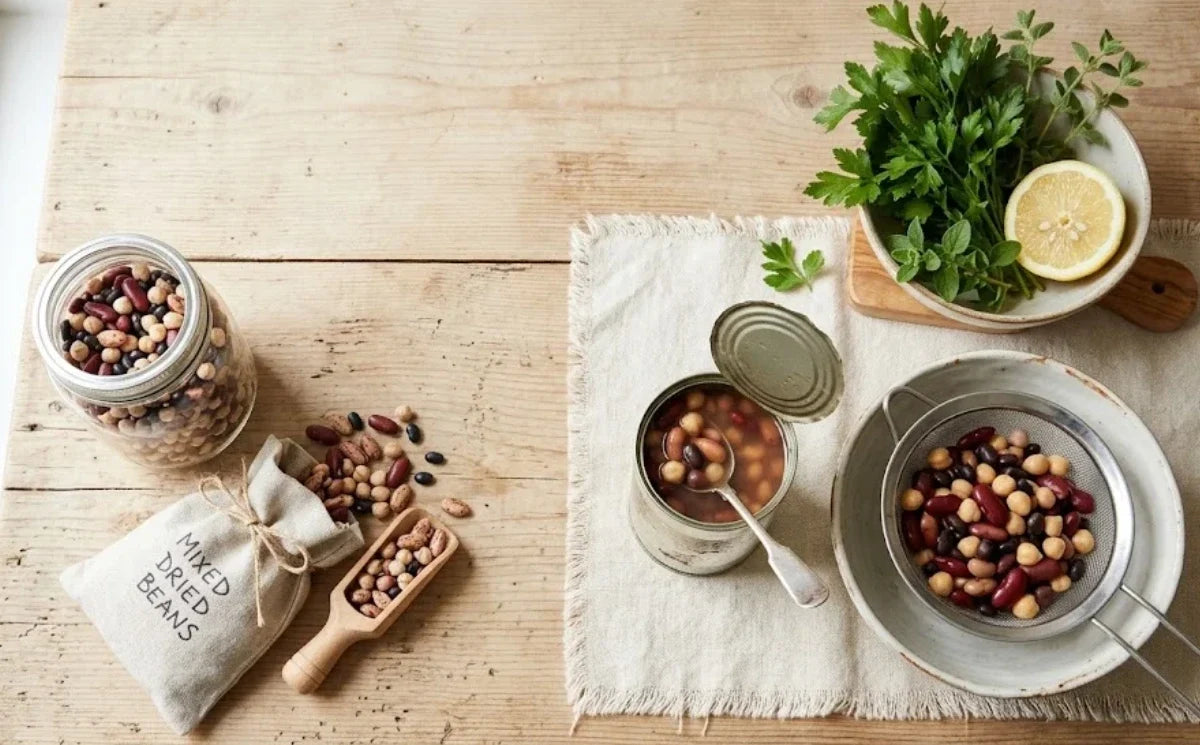
Beans are one of the most affordable, nutritious foods in your pantry, and they come two ways: ready in a can, or dry in a bag. If you've ever stood in the aisle wondering whether canned beans or dried beans are the better buy, you're not alone. This guide compares them on what matters: nutrition, sodium, BPA, cost per serving, soaking time, flavor and shelf life, and tells you when each one makes sense.
Quick Answer
Both are healthy, so the best choice depends on your priorities. Canned and dried beans have comparable protein, fiber and minerals. Dried beans usually win on sodium (plain dried beans have little to none until you add salt), flavor and texture control, and often cost per serving. Canned beans win on convenience: they're fully cooked and ready in a minute. Draining and rinsing canned beans cuts sodium by roughly 20 to 40%, so it's worth doing every time. Keep both in your pantry and use each where it fits.
Canned Beans vs Dried Beans at a Glance
|
Feature |
Canned beans |
Dried beans |
|
Prep time |
About a minute (drain and rinse) |
1 to 2 hours on the stove after soaking, or about 20 to 45 minutes in a pressure cooker |
|
Soaking |
None |
Optional; 6 to 8+ hours or a quick soak |
|
Sodium |
Often added; a serving of canned pinto beans has about 270 mg |
0 to 15 mg per serving until you add your own salt |
|
Nutrition |
Comparable protein, fiber and minerals |
Comparable protein, fiber and minerals |
|
Cost |
Higher per cooked cup in most stores |
Usually lower per cooked cup when comparing like with like |
|
Flavor and texture |
Softer, more uniform, can taste salty or "canned" |
Firmer or creamier as you choose, with more flavor |
|
Storage |
Shelf-stable until the date on the can |
Shelf-stable; best used within about 1 year |
|
Packaging |
Metal can with a protective lining |
Bag, no lining |
Are Dried Beans Healthier Than Canned Beans?
Not by much. Nutritionally, canned and home-cooked beans are comparable. Dietitian Gena Hamshaw sums it up: "Dried or canned, beans are nutritional all-stars", providing fiber, plant protein, iron, magnesium, potassium and zinc. The real difference is the sodium that gets added to canned beans, and a few practical details:
- Canned beans are already cooked, so there's nothing to leave out of the nutrition equation except what's added to the liquid.
- Rinsing helps but isn't free. Draining and rinsing removes sodium, but some sources note it may wash away a small amount of other nutrients along with it.
- Dried beans let you control what goes in. You choose the salt, spices and cooking liquid.
So are dried beans healthier than canned? They're equally nutritious, but dried beans are the easier way to keep sodium low. If you cook beans often, they're the better default. If canned beans are what gets beans on your plate, they're still a great choice. Read more about their benefits in our guide to the advantages of eating beans and the 7 health benefits of black beans.
Sodium in Canned Beans vs Dried
This is the biggest difference.
- Canned beans: USDA data shows a serving of canned pinto beans contains about 270 mg of sodium, or about 12% of the daily recommended limit. Reduced-sodium cans can be much lower. One example showed 240 mg per serving versus 450 mg for regular canned black beans.
- Dried beans: about 0 to 15 mg per serving before you add salt.
Do canned beans have more sodium? Yes. But you can cut it down. Labs have measured how much draining and rinsing removes:
- America's Test Kitchen found about 100 mg less sodium per ½-cup serving, or 20.7% to 26.5% depending on the product.
- Tufts' Health & Nutrition Letter reports that draining alone cut sodium by 36%, and draining plus thorough rinsing by about 40%.
- Another bean guide puts it at 35% or more.
The takeaway: drain and rinse canned beans, choose no-salt-added or low-sodium cans if you can, and know that rinsing roughly removes a quarter to a third or more of the sodium. Add salt yourself at the end, if at all.
What About BPA in Canned Beans?
BPA (bisphenol A) is a chemical used in some can linings to keep food from touching bare metal. Here's the balanced picture:
- The FDA says BPA is safe at current levels in food packaging, and that the available information supports the safety of its approved uses. It notes that small amounts can migrate from the coating into food, and says it will take action if its assessment changes.
- Independent testing has found BPA in many canned foods. A Consumer Reports test (2009, so dated) found BPA in a wide range of canned foods, including canned green beans, and even found some in cans marketed as "BPA-free".
- If you'd like to limit exposure, choose dried beans (no can lining) or beans in cartons or jars, and look for brands that say their cans are BPA-free.
You don't need to avoid canned beans, but if BPA is a concern, dried beans take it off the table.
How Much Cheaper Are Dried Beans Than Canned?
Is it cheaper to buy dried beans? In most stores, yes, cup for cup. The numbers work like this:
- A 15-ounce can costs roughly $1 and yields about 1½ to 1¾ cups of cooked beans (about 9 ounces drained).
- A pound of dried beans yields about 4 to 6 cups cooked, roughly 3½ cans' worth, and costs about $2 to $3 in a typical grocery example.
That's roughly $0.60 to $0.85 per can-equivalent from dried, versus about $1 for the can, and the gap grows when you buy in bulk.
Cost per serving: do the math yourself
The simple formula is:
price per pound ÷ cups of cooked beans per pound (4 to 6) = cost per cooked cup
Compare that with price per can ÷ 1½ to 1¾ cups. Always compare like with like: organic dried with organic canned, or conventional with conventional. Specialty varieties such as organic heirloom or Korean black soybeans cost more per pound than a standard grocery bean, because you're paying for the variety, and those often aren't available in cans at all.
Is it worth it to cook dried beans?
Yes, if you cook beans regularly, because you save money, control the sodium, and can cook a big batch at once and freeze the extra. If you eat beans only occasionally and value your time, a few cans on the shelf are perfectly reasonable.
Soaking and Cooking Time: Dried vs. Canned
How long does it take to cook dried beans compared to opening a can? A can takes a minute. Dried beans take longer, but most of it is hands-off time:
- Soak (optional): cover beans with plenty of water and soak 6 hours or overnight.
- Quick soak: boil the beans for 2 minutes, turn off the heat and let them stand for 1 hour.
- Simmer: after soaking, most beans cook in 1 to 2 hours on the stovetop, until a fork mashes them easily.
- Pressure cooker: about 20 to 25 minutes for soaked beans and 40 to 45 minutes for unsoaked beans, on high pressure.
A few tips from cooks and extension services:
- Add salt and acidic ingredients (tomatoes, lemon, vinegar) only after the beans are tender, because adding them early slows softening.
- Soaking is optional but helpful. It rehydrates beans that have dried out on the shelf, and it helps with gas: soak, discard the soaking water, and cook in fresh water. See our guide to why beans and lentils give you gas for the science and four fixes.
- Cook kidney beans thoroughly. Raw or undercooked red kidney beans contain a toxin, so always soak them and boil them hard before simmering. Our gas guide also covers kidney bean safety.
Looking for ideas to use them? Try 6 hearty bean soups and 11 delicious ways to eat black beans, and see the most popular beans in the US.
Do Dried Beans Taste Different From Canned?
Yes, usually. Many cooks find dried beans more flavorful, and cooking them yourself lets you choose the texture (firm for salads, creamy for soups and dips) and season the cooking liquid with onion, garlic, bay leaf or kombu. Canned beans tend to be softer and more uniform, and some have a noticeably salty or "canned" taste that rinsing helps tame. Dried beans also come in far more varieties than most cans do, including adzuki, cranberry and black soybeans.
Shelf Life, Storage and Bulk Buying
- Both are shelf-stable. Canned beans keep until the date printed on the can, and dried beans keep for a long time in an airtight container. For best quality, use dried beans within about a year, because older beans lose moisture and take longer to cook.
- Bulk buying works best with dried beans. Buy the amounts you'll use, store them in an airtight container in a cool, dark place, and stock up when your favorites are on sale.
- Cook once, eat all week. Cooked beans keep best stored in their cooking liquid, and they freeze well in portions.
SFMart's organic bean collection is a good place to stock up, with options such as dark red kidney beans, garbanzo beans, cranberry beans, adzuki beans and black beans, plus a mixed bean. You can also browse the wider organic beans and lentils collection, or the organic lentil collection.
So Which Should You Buy? A Quick Decision Guide
|
Choose canned if... |
Choose dried if... |
|
You need beans in a few minutes |
You cook beans often and can plan ahead |
|
You rarely cook beans |
You want to cut sodium and control seasoning |
|
You have limited time or equipment |
You want the lowest cost per serving |
|
You want a shelf-stable emergency option |
You want more variety and better flavor |
|
You'll drain and rinse them anyway |
You'd rather avoid can linings (BPA) |
The practical answer: keep a few cans (low-sodium or no-salt-added) for quick meals, and a few pounds of dried beans for the dishes where flavor, texture and cost matter. Cook a big batch on the weekend and you get the best of both.
Final Thoughts
Canned and dried beans are both good for you, so the best one is the one that gets beans onto your plate. Reach for dried beans when you want the lowest sodium, the best flavor and the best value, and keep rinsed, low-sodium cans on hand for the nights you need dinner fast.
Ready to stock the pantry? Browse SFMart's organic beans, then read why beans give you gas and the most popular beans in the US for what to cook next.


