
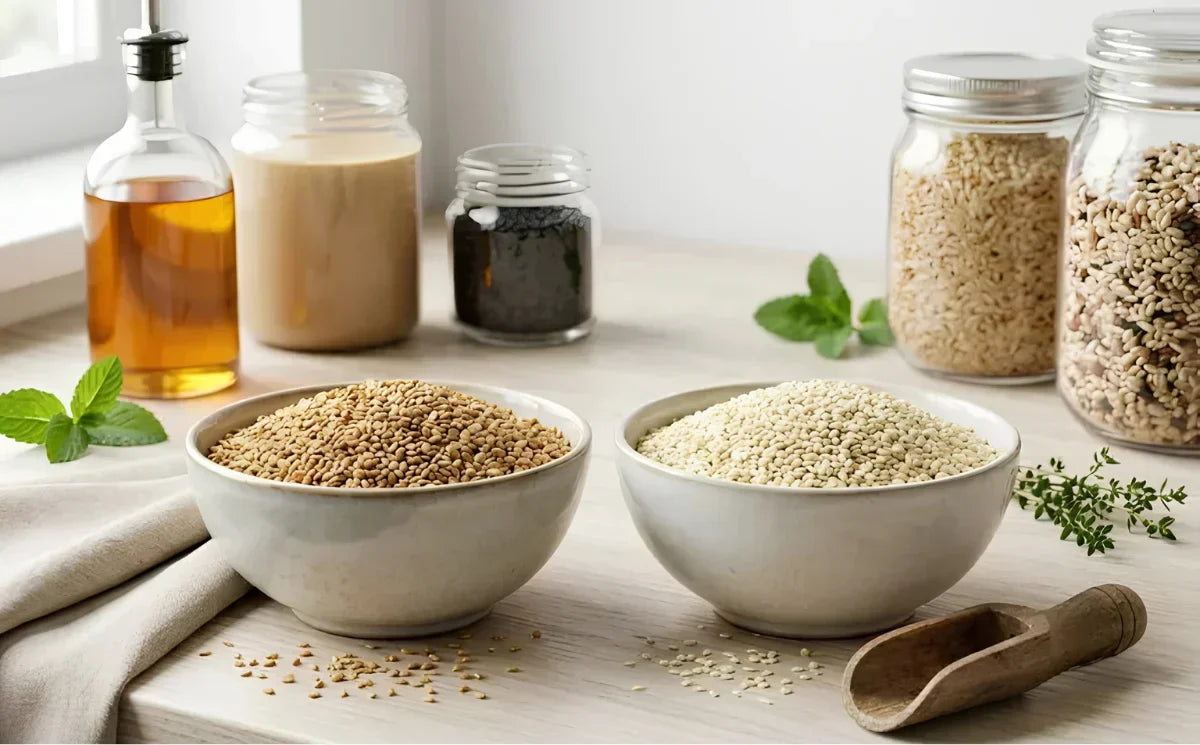
Sesame seeds are one of the oldest oilseed crops in the world, and today they're a pantry staple far beyond their classic role as a bagel or bread topping. Sprinkled on stir-fries, blended into tahini, or pressed for oil, sesame seeds pack an impressive nutritional punch; but not all sesame seeds are created equal. The biggest variable? Whether the outer hull has been removed.
In this guide, we break down exactly what changes nutritionally when sesame seeds are hulled versus left whole, so you can choose the right variety for your health goals and your recipes.
Whole (Unhulled) vs Hulled Sesame Seeds: What's the Difference?
- Whole/unhulled sesame seeds retain their thin, light-brown outer skin (the hull).
- Hulled sesame seeds have had that skin removed, leaving a smaller, paler, more delicate kernel.
The hull itself is where much of the seed's bran, fiber, and mineral content is concentrated which is why removing it changes the nutritional profile more than most people expect.
It takes roughly 1,000 tiny sesame seeds to make up just a single 1-ounce serving, so even small differences in composition add up across a serving.
Basic Nutritional Value: Calories, Fat, Protein & Carbs
When it comes to core macronutrients, whole and hulled sesame seeds are nearly identical. A 1-ounce (28g) serving of either variety provides approximately:
- 160 calories
- 13.6 grams of fat (mostly heart-healthy unsaturated fat)
- 4.8 grams of protein
- 7.3 grams of carbohydrates
So if you're simply counting calories or macros, it doesn't matter much which type you choose. The real differences show up in micronutrients minerals, vitamins, fiber, and plant compounds.
Cooking with black sesame seeds too? Avoid the common slip-ups that dull their flavor and nutrition; from over-toasting to poor storage. Check out Mistakes to Avoid When Cooking With Organic Black Sesame Seeds for practical tips to get the most out of every batch.
Dietary Fiber: Hulled vs Unhulled Sesame Seeds
Both types are a solid source of fiber, delivering just over 3 grams of dietary fiber per 1-ounce serving. However, whole sesame seeds edge out hulled seeds slightly when it comes to insoluble fiber, since the bran-rich hull is where most of that fiber lives. If digestive health and regularity are a priority, unhulled sesame seeds have a slight advantage.
Minerals: Calcium and Iron Are Where It Really Counts
This is the category with the starkest contrast between the two varieties:
|
Nutrient (per 1 oz) |
Whole/Unhulled Sesame Seeds |
Hulled Sesame Seeds |
|
Calcium |
~280 mg |
Less than 20 mg |
|
Iron |
~4 mg |
~1.8 mg |
That's a massive gap; unhulled sesame seeds provide more than 14 times the calcium and over 2x the iron of hulled seeds. If you're using sesame seeds as a plant-based source of calcium or iron (common for dairy-free or vegetarian diets), whole sesame seeds are the far better choice.
Both varieties are still good sources of zinc, phosphorus, and magnesium, so you won't miss out on those minerals either way.
Vitamins: A Slight Trade-Off
Sesame seeds are a meaningful source of B vitamins; particularly thiamine, vitamin B-6, niacin, and folate.
- Whole sesame seeds are slightly higher in thiamine and vitamin B-6.
- Hulled sesame seeds are slightly higher in niacin and folate.
- Vitamin E is where hulled seeds pull ahead significantly; a 1-ounce serving of hulled sesame seeds contains almost 7 times as much vitamin E as the same serving of whole seeds.
If antioxidant vitamin E is your priority, hulled seeds have the edge. For broader B-vitamin balance tied to energy metabolism, whole seeds hold their own.
Phytonutrients: Lignans and Antioxidants
With or without the hull, sesame seeds are an excellent source of antioxidants and polyphenols, especially lignans; plant compounds linked to several health benefits.
Research highlighted by the Linus Pauling Institute associates diets rich in plant lignans with a reduced risk of heart disease and potential protection against certain hormone-related cancers. A 2007 review in Critical Reviews in Food Science and Nutrition also found that sesame lignans may help promote healthy cholesterol levels and support healthy blood pressure.
Because lignans are present throughout the seed (not just the hull), both hulled and unhulled sesame seeds deliver this benefit.
So, Which Sesame Seeds Should You Buy?
|
Choose whole/unhulled sesame seeds if you want... |
Choose hulled sesame seeds if you want... |
|
Higher calcium and iron intake |
More vitamin E |
|
More insoluble fiber |
A milder flavor and finer texture |
|
A rustic, nutty flavor for baking and topping |
Smooth tahini and delicate garnishes |
|
More thiamine and vitamin B-6 |
More niacin and folate |
Many people simply keep both on hand whole seeds for baking, roasting, and topping where texture and nutrition matter most, and hulled seeds for tahini, dressings, and dishes where a lighter color and flavor are preferred.
Shop Related Products at SFMart
- Organic Sesame Seeds the whole/unhulled variety featured in this article, ideal for baking, roasting, and boosting calcium and iron intake.
- Sesame Oil made from hulled sesame seeds for a smooth, creamy finish.
- Explore more pantry staples and superfoods in the SFMart Grocery collection.


